EV Range in Hot Weather and Freezing Cold: What Really Happens
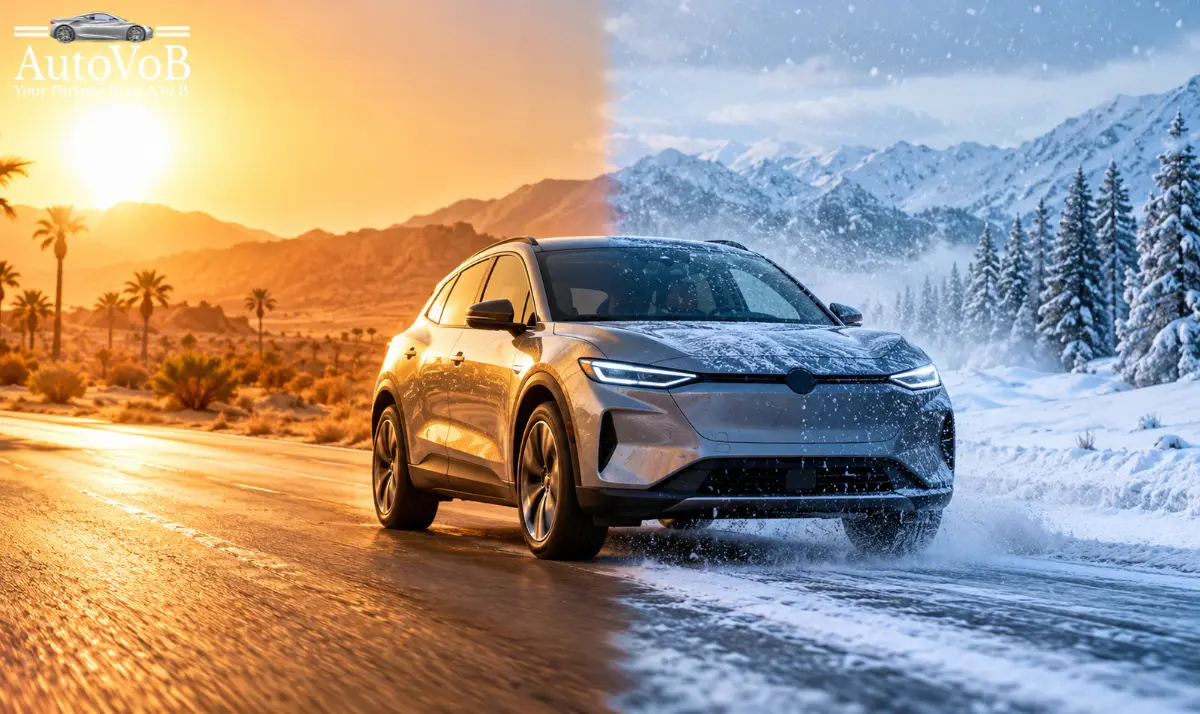
When AAA chilled three current EVs to -7°C this spring, they lost 39% of their range on average. At 35°C, the same cars lost 8.5%. If you've been told EV range in hot weather is the thing to fear, those two numbers say otherwise, at least on the day you drive. Heat does its damage more slowly, over years, inside the battery.
I've had this conversation with plenty of buyers on dealer forecourts, and most of them have it backwards. Here's what the latest testing shows, why the cold hurts so much more, and what it means if you're buying or selling an EV.
What the 2026 tests found
AAA ran its tests on climate-controlled dynamometers, comparing three EVs and three hybrids, including a Tesla Model Y and a Chevrolet Equinox EV, against a baseline of 22°C. At -7°C (20°F), the EVs lost 39% of their range and 35.6% of their efficiency. A car that covers 400 km on a mild day manages about 244 km. At 35°C, they lost 8.5% of range and 10.4% of efficiency. AAA put the extra winter running cost at about $32 per 1,000 miles for an owner charging at home.
Hybrids weren't spared. Their fuel economy fell 22.8% in the cold and 12% in the heat, and AAA's director of automotive engineering admitted the cold result for hybrids surprised him.
AAA's 2019 study, with a different set of cars, found a 41% cold-weather loss with the heater on and 17% in the heat with the AC running. AAA warns that the different line-up makes direct comparison tricky, but my read is simple. Carmakers have got much better at handling heat. They've barely moved on cold.
Why EV range in cold weather drops so far
Two things happen when it's freezing. The chemistry inside a lithium-ion battery slows down, so less power is available. And the car has to make its own heat. A petrol engine wastes enough heat to warm the cabin for free. An electric motor is so efficient that it doesn't, so the heater draws on the same battery that drives the wheels. Recurrent, which analyses real-world data from more than 30,000 US EVs, says cabin heating is the main reason for winter range loss.
That's where heat pumps earn their place. Recurrent says a heat pump can produce three to four units of heat for every unit of electricity, and that it adds about 10% to range at 0°C. The advantage fades as temperatures fall toward -18°C, where a heat pump is about as efficient as a plain resistive heater.
Across the 34 models in Recurrent's 2025/2026 winter study, EVs kept an average of 78% of their range at 0°C and 70% at -7°C. The best kept 88% and the worst 69%. Tesla's models sat near the top. Several GM models, including the Cadillac Lyriq and Chevrolet Equinox EV, lagged despite having heat pumps, and Recurrent believes GM lets its resistive heater kick in earlier to keep passengers warmer. A spec sheet that says heat pump doesn't settle the question on its own.
Real roads in a real winter are harsher still. In January, Norway's automobile federation ran its El Prix test with 24 EVs in temperatures as low as -32°C. On average, the cars fell 38% short of their official WLTP range. The Lucid Air went furthest, at 520 km, but that was 45.8% below its rated 960 km. The Hyundai Inster and MG S6 had the smallest shortfall among production cars, at 28.9%.
None of this is permanent. Recurrent says winter range loss leaves no long-term mark on the battery, and range returns to normal as temperatures rise.
EV range in hot weather is the smaller problem on the road
Summer is gentler because the air conditioning has less work to do. Recurrent points out that a cabin usually needs cooling by about 11 to 14°C in summer, against roughly 28°C of heating in winter. Pulling a 35°C car down to about 21°C takes 3 to 5 kW, but holding it there takes around 1 kW. Up to about 32°C, Recurrent's data shows a range loss of only 2% to 5%.
Its 2025 summer study of 29,719 EVs turned up a detail I like to tell buyers. Cars with heat pumps lost more range in the heat, 7% at 32°C and 15% at 38°C, against 3% and 13% for cars without one. Heat pumps are tuned for winter. If you live somewhere hot, don't pay extra for one expecting a summer benefit.
Where heat really costs you: EV battery temperature over the years
The real threat from heat is ageing. A Geotab study of more than 22,700 EVs, published in January, found batteries lose 2.3% of their capacity a year on average. Cars in its hot climate group, which saw more than 35% of days above 25°C, degraded about 0.4% a year faster than cars in mild climates.
Charging habits mattered more. Cars that leaned heavily on DC fast chargers above 100 kW lost about 3.0% a year, double the 1.5% for cars charged mostly on AC. For an owner in a hot country, that's the useful finding. You can't change the weather, but you can charge at home overnight and save fast chargers for road trips.
Cold batteries charge slowly too
Range isn't the only thing that drops in winter. Recurrent notes that many EVs limit charging power when the battery is cold, to protect it, so a fast-charge stop takes longer. Most newer EVs will warm the battery on the way if you set the charger as your destination in the car's own navigation. El Prix showed the payoff. With battery preconditioning, many of the test cars came close to their claimed 10% to 80% charging times, even in Norway's January cold.
Habits that claw back range
Precondition the cabin and battery while the car is still plugged in, so the energy comes from the grid and not the battery. Use heated seats and the heated steering wheel and turn the cabin heater down, because AAA says heating the driver directly is far more efficient than heating the whole cabin. In winter, AAA advises keeping the battery above 50%, and Recurrent suggests leaving the car plugged in with a 70% or 80% charge limit so it can keep itself warm from the wall. In summer, pre-cool while plugged in and park in the shade. In any season, correct tyre pressures and moderate speeds help.
Also Read: Is DC Fast Charging Killing Your EV Battery?
Buying or selling an EV with the weather in mind
If you're buying, look up real-world winter results for the exact model, trim and year, not just whether it has a heat pump. On a used EV from a hot region, ask for an independent battery health test, because that's where years of heat show up. And don't judge a used EV on a cold-morning test drive. The range estimate on the dashboard will look grim, and it'll recover in spring.
If you're selling in winter, charge the car fully and precondition it before a viewing, so the buyer sees the range the car really has once it's warm. A battery health report will do more to close the sale than any argument about the weather.
These findings reflect current test data and studies as of October 2026. Official range figures come from government test procedures such as the EPA cycle in the US and WLTP in Europe, which regulators can revise at any time, and carmakers change thermal management through software updates, so check the latest figures for the car you're considering.
The advice I give buyers is short. Plan for winter, and worry about heat over the long term. A healthy EV that loses a third of its range at -7°C gets it all back in April. A battery worn down by years of heat and fast charging doesn't, and that's the loss worth guarding against.
FAQs
1. How much range does an EV lose in hot weather?
In AAA's 2026 tests, EVs lost an average of 8.5% of their range at 35°C. Recurrent's real-world data shows only a 2% to 5% loss up to about 32°C, because the air conditioning has far less work to do in summer than a cabin heater does in a freezing winter.
2. How much range does an EV lose in cold weather?
AAA's 2026 tests found EVs lost 39% of their range at -7°C with the heater in use. Recurrent's real-world data from more than 30,000 US EVs shows an average of 78% of range kept at 0°C and 70% at -7°C, with big gaps between individual models and brands.
3. Does a heat pump improve EV range?
In winter, yes. Recurrent found a heat pump adds about 10% to range at 0°C, though the benefit fades near -18°C. In summer it doesn't help: heat pump EVs lost 7% of their range at 32°C in Recurrent's 2025 summer study, against just 3% for cars without one.
4. Does hot weather damage an EV battery?
Over time, a little. Geotab's 2026 study of more than 22,700 EVs found batteries in hot climates degraded about 0.4% a year faster than in mild ones. Frequent DC fast charging above 100 kW mattered more, pushing degradation to about 3.0% a year on average.
5. Is winter EV range loss permanent?
No. Recurrent says cold-weather range loss is temporary and doesn't harm the battery long term, so full range returns as temperatures rise. Preconditioning while plugged in, using heated seats and keeping the battery above 50% all reduce the winter drop.
Keep visiting AutoVoB Blogs to stay ahead in your automotive knowledge.