Fahas Saudi Arabia: Complete Vehicle Inspection Guide
A Fahas inspection costs SAR 115 for a private car, and driving without a valid one can cost you SAR 150 to SAR 300 in fines. On the money alone, skipping it is a bad bet. Most owners who get caught out by Fahas in Saudi Arabia aren't dodging it, though. They lose time and money to a dead bulb, a missed re-inspection window or an appointment they never booked.
Here's how the rules work right now, what happens in the lane, and how buyers and sellers should use the result.
How Fahas in Saudi Arabia works and who runs it
Fahas is the everyday name for the periodic technical inspection, which you'll also see called MVPI, short for motor vehicle periodic inspection. The Saudi Standards, Metrology and Quality Organization, known as SASO, oversees it through its Vehicle Safety Center and licenses the companies that run the stations.
The network has grown quickly. In June 2025, SASO said there were 44 fixed inspection sites, up from 29 before the Vehicle Safety Center took over, plus 14 mobile inspection units working out of 16 approved. Stations inspected 5.8 million vehicles in 2024, double the 2.9 million inspected in 2019.
When your car needs vehicle inspection in KSA
A new private car gets its first inspection three years after it's first licensed, then every year after that. Taxis, buses and public transport vehicles start after two years, then also go yearly. The traffic department confirmed these intervals on X in September 2026.
You'll feel it most at renewal. You can't renew your istimara without a valid inspection, and renewal also needs valid insurance and any fees and fines paid. Foreign-registered cars must be inspected within 15 days of entering the Kingdom if they don't carry a recognised inspection certificate from abroad. A valid inspection is also a condition for transferring ownership, which matters to anyone selling.
Timing deserves more thought than most people give it. You can inspect at any point before your current inspection expires, but the new validity runs from the date of the new pass. Go two months early and you've thrown away two months. My rule is to book for about three or four weeks before expiry, which leaves room to fail, fix the fault and get back for a re-inspection before the old certificate runs out.
Fahas fees and what a fail really costs
A private car costs SAR 115, made up of SAR 100 plus SAR 15 VAT, and taxis pay the same. Motorcycles cost SAR 51.75, medium trucks SAR 162.15 and large trucks and buses SAR 235.75, all including VAT. Booking the appointment is free, and you can pay at the station by mada or cash.
The re-inspection rules are where people waste money. If your car fails, you get a report listing every fault. You then have 14 working days and two chances to come back, and each re-inspection costs SAR 37.95. Only the failed items are checked again, unless new faults turn up, and you can use any station. Miss the 14 days or fail both attempts and you pay the full SAR 115 again for a complete inspection.
In practice, a blown brake light bulb you fix this week costs you about SAR 38 and a second trip. The same bulb ignored for three weeks costs you SAR 115.
Stations don't charge a late fee. Driving on an expired inspection is a traffic violation, though, and the traffic department lists it in the third category, with a fine between SAR 150 and SAR 300. The higher end is applied only by traffic adjudication committees when there are grounds to increase it.
How to book a Fahas appointment
Every vehicle type now needs an appointment before it goes to a station. You can book through SASO's unified periodic inspection platform, its official Vehicles Safety app or, since 2026, Tawakkalna. You enter your personal details and the vehicle data from the registration, then choose the region, vehicle type and service, which is either a periodic inspection or a re-inspection. Imported cars that aren't registered yet use the customs card. Then pick a station, date and time and confirm. You can change or cancel it later on the same platform.
Bring the appointment confirmation, the owner's ID, which is the iqama or national ID, and the vehicle registration, either the printed istimara or the digital version on your phone. You don't need to clear outstanding traffic fines before the inspection.
If you're taking someone else's car, the owner has to authorise you on the platform. You can skip that if you're a driver authorised through Absher, the actual user named on the registration, a son or daughter bringing a parent's car, a sponsor bringing a dependant's car, or you hold a legal power of attorney.
One warning. In late August 2026, SASO told people not to deal with individuals or online accounts offering to issue the inspection document or help them get it through unofficial channels, and said the document comes only through its official website. Anyone who promises you a pass without the car going down a lane is selling you trouble, and you've handed them your personal details as well.
What happens in the inspection lane
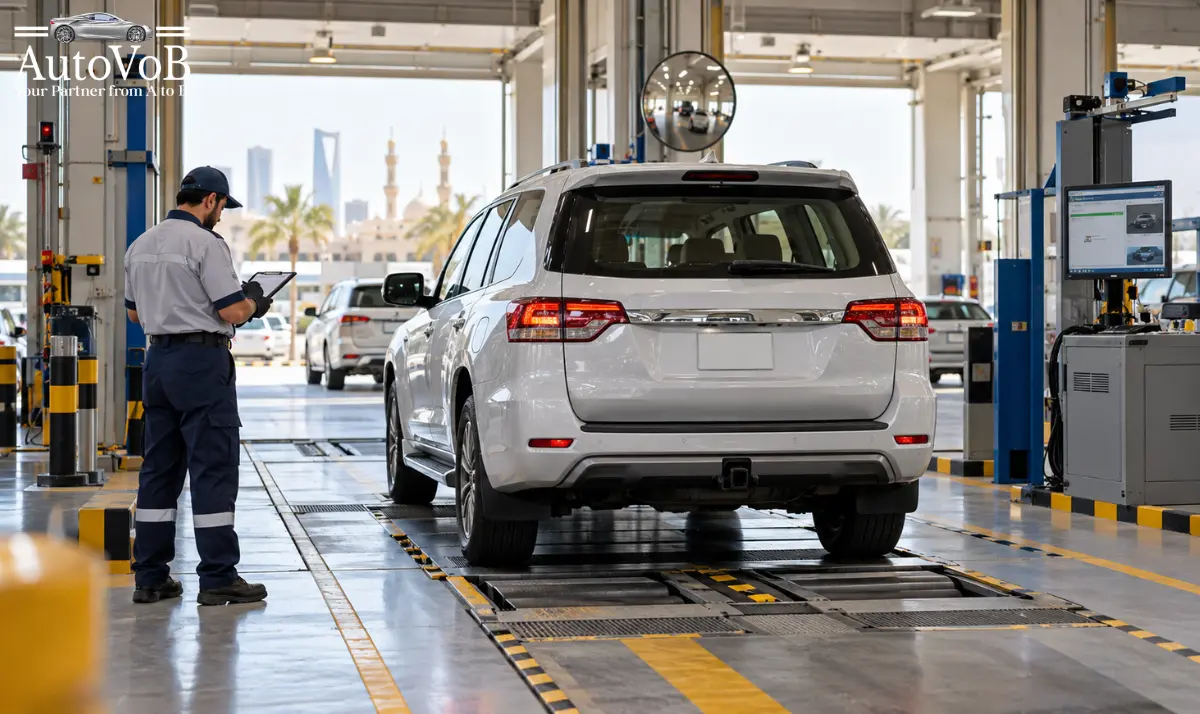
For light vehicles, sources state that the inspection runs through five stages covering more than 40 items. You hand over the car and wait on the side walkway while the inspectors work, so take your valuables out first.
The usual reasons for failing are dull ones: damaged tyres or tread below the legal depth, lights that don't work, brake faults, oil or other fluid leaks and exhaust emissions above the limit. Most of those are visible on your own driveway. Walk around the car with the lights on, have someone watch the brake lights and indicators while you press the pedal and flick the stalk, and look at the ground where the car sits overnight. It takes ten minutes and saves you a second visit.
A warning triangle and fire extinguisher are currently only a warning item for private cars, while heavy vehicles must carry them. I'd keep both in the boot anyway, because they cost very little.
If the car passes, the inspector puts a sticker on the front windscreen, and a replacement for a damaged one costs SAR 50 plus VAT. The result should then show in Absher. If it doesn't, check that the registration, the chassis number on the car and the certificate all match. The traffic department fixes registration errors, and the station fixes mistakes on the certificate.
Using an MVPI Saudi result to buy or sell a car
For sellers, the ownership transfer rule decides the order of jobs. If your Fahas expires within a couple of months, inspect before you list, because a buyer who finds an expired certificate either walks away or asks for money off. Fix the cheap faults first, so the report you show buyers is clean.
For buyers, check the inspection status yourself on Absher or SASO's status page using the car's registration, and don't rely on the sticker alone. Ask to see the last inspection report too. A car that needed both re-inspections last year tells you something about how its owner maintains it.
Keep the result in proportion, though. A pass means the car met the inspection's safety and emissions checks on the day it was tested. In my view, it isn't a pre-purchase inspection, and I wouldn't treat it as one on any car worth serious money. Pay an independent workshop to look at the engine, gearbox and signs of accident repair before you hand over the money.
Also Read: How to Renew Vehicle Registration in KSA
Before you book
Everything here reflects current information from SASO, the General Department of Traffic and official announcements as of October 2026. The Saudi government and its traffic and standards authorities can change inspection intervals, fees, fines and booking rules at any time, so check the official SASO platform or Absher before you book or sell.
Fahas is cheap, quick and predictable once you know how it works. Book three or four weeks before expiry, check your lights and tyres the night before, and fix any fault inside the 14-day window. Do that and the whole thing costs you SAR 115 and one morning a year.
FAQs
1. How much does Fahas cost in Saudi Arabia?
A private car costs SAR 115, which is SAR 100 plus SAR 15 VAT. Motorcycles cost SAR 51.75, medium trucks SAR 162.15 and large trucks and buses SAR 235.75. A re-inspection for a private car after a failed test costs SAR 37.95 including VAT, and booking the appointment itself is free.
2. When does a new car need its first vehicle inspection in KSA?
A new private car needs its first periodic inspection three years after it is first licensed, then once every year. Taxis, buses and public transport vehicles start after two years and are also inspected yearly after that. You can't renew the istimara without one.
3. How do I book a Fahas appointment?
Book through SASO's unified periodic inspection platform, the official Vehicles Safety app or Tawakkalna. Enter your details and the car's registration data, choose the region, vehicle type, service, station, date and time, then confirm. Every vehicle type needs a booking.
4. What happens if my car fails Fahas?
You get a report listing every fault on the car. Fix them and return to any station within 14 working days, with two re-inspection chances at SAR 37.95 each, checking only the failed items. Miss the window or fail twice and you pay SAR 115 again for a full inspection.
5. What is the fine for driving with an expired MVPI in Saudi Arabia?
Driving without a valid periodic inspection is a third-category traffic violation with a fine of SAR 150 to SAR 300. The higher amount is applied only by traffic adjudication committees when there are grounds to increase it. Stations themselves charge no late fee.
For more fresh updates from the world of wheels, keep following AutoVoB Blogs.