Electro-Hydraulic Power Steering (EHPS) Explained
Most drivers never think about what happens between turning the steering wheel and the wheels actually changing direction. It just works. But the engineering behind that effortless response has gone through several generations of refinement. Electro-Hydraulic Power Steering, or EHPS, is one of the more interesting chapters in that story, a system that sits between old-school hydraulics and the fully electric steering found in most new cars today.
Understanding EHPS matters if you drive a mid-size sedan, an SUV, or a commercial vehicle built in the last two decades. Chances are higher than you'd expect that this is exactly what's steering your car.
What EHPS Actually Is
EHPS uses the same fundamental principle as traditional hydraulic power steering: pressurized fluid helps multiply the force you apply at the wheel. The critical difference is where that pressure comes from.
In a conventional hydraulic system, a pump is driven directly by the engine via a belt. It runs constantly, whether you're turning or traveling in a straight line for an hour on a highway. That's a lot of wasted energy.
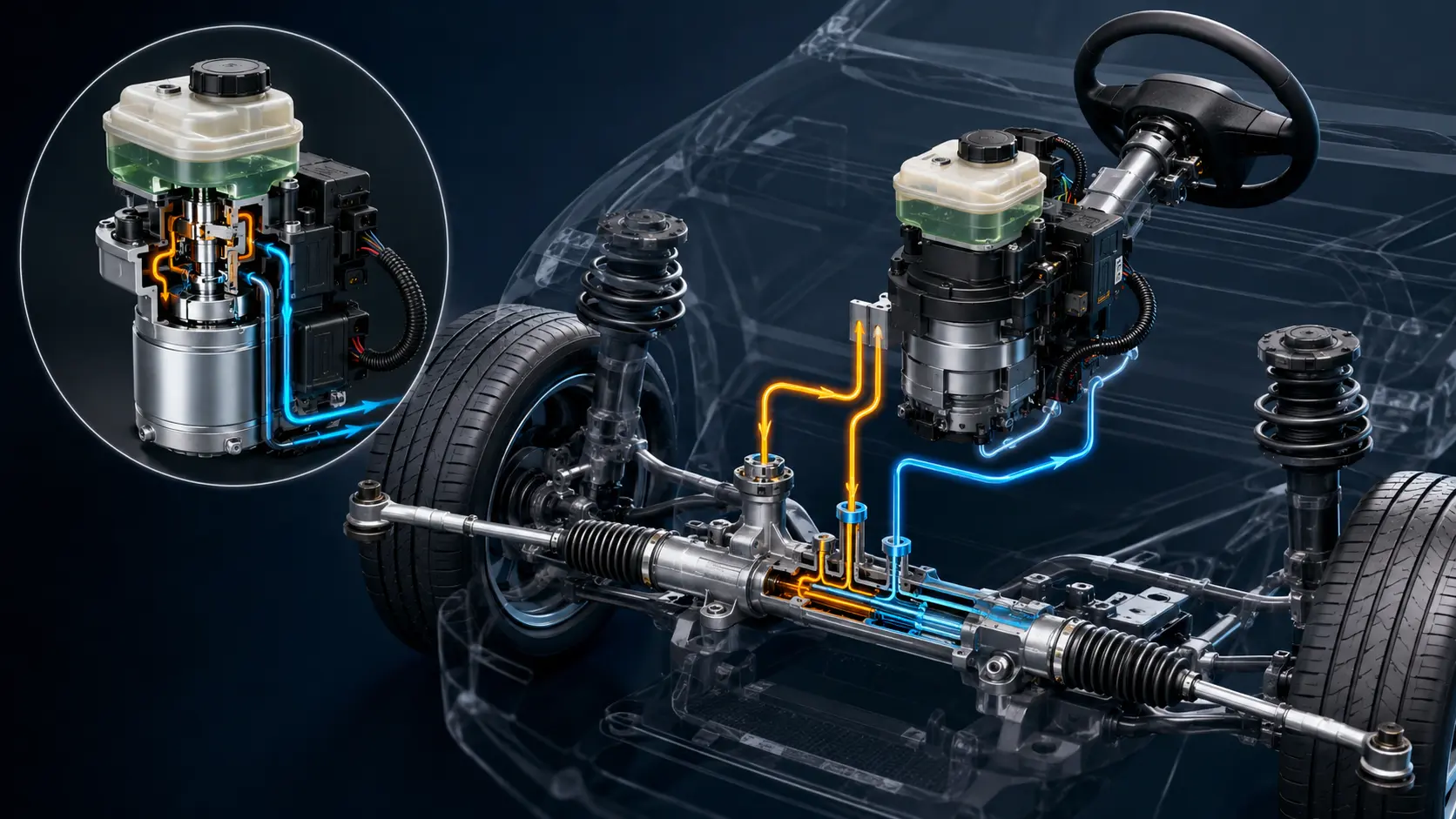
EHPS breaks that connection. The hydraulic pump is driven by an electric motor instead of the engine belt. This motor pump unit, often called the MPU, activates on demand. When you're not steering, the pump largely idles. When you turn, it delivers the pressure needed. The rest of the system, the rack-and-pinion, the control valve, the hydraulic cylinder, remains essentially unchanged from a traditional setup.
This distinction sounds subtle but has meaningful consequences for fuel consumption, control, and driving feel.
How the System Works Step by Step
When you turn the steering wheel, a torque sensor picks up the direction and magnitude of your input. At the same time, the vehicle speed sensor sends speed data to the EHPS electronic control unit, or ECU. The ECU processes both signals and decides how much hydraulic pressure the pump needs to generate.
At low speeds, say, parking in a tight space, the ECU tells the motor to run fast and push a high volume of fluid. The result is light, easy steering. At highway speeds, the motor slows down, pressure drops, and the steering firms up. That "heavy at speed, light in a car park" behavior is what engineers call speed-sensitive assist, and it's something traditional hydraulic systems struggled to deliver without significant add-on complexity.
The separator piston inside the steering cylinder splits it into two chambers. Pressure is directed into whichever chamber corresponds to the direction you're turning. Once the maneuver is complete, fluid cycles back to the reservoir and the loop closes.
The MPU itself is a compact unit: an electric motor at the base, a hydraulic pump above it, and often an integrated controller and fluid reservoir on top, stacked like layers, self-contained, and independent of the engine.
EHPS vs. Traditional Hydraulic Steering vs. EPS
To understand where EHPS fits, it helps to line up the three main options.
Traditional hydraulic power steering (HPS) gives strong assist and a natural, connected feel. The road communicates well through the wheel. The downside is efficiency: the pump draws from the engine at all times, burning fuel even when you're not steering. Researchers have estimated that over 70% of the energy consumed by a conventional HPS system is effectively wasted.
Full electric power steering (EPS) replaces hydraulics entirely. An electric motor mounted on the steering column or rack provides the assist. EPS is lighter, more efficient, easier to integrate with driver assistance systems, and has no fluid to leak or top up. The trade-off, particularly in earlier implementations, was steering feel. Some drivers found it too light, too artificial, like steering a video game rather than a car. Calibration has improved considerably, but the criticism still surfaces for certain models.
EHPS sits between them. It keeps the hydraulic actuation that delivers strong, natural-feeling assist, but adds electronic control and cuts the engine dependency. You get the road feel of HPS with measurably better efficiency and the ability to tune behavior based on speed. For automakers upgrading from HPS, the chassis modifications needed are minimal, the hydraulic pipework and rack architecture can remain in place.
The Fuel and Efficiency Question
One of the most cited reasons manufacturers adopted EHPS was fuel consumption. Because the pump only runs when steering is actually happening, it reduces energy draw compared to a continuously running engine-driven pump. The improvement sits around 20% in energy consumption versus traditional HPS. A demonstration vehicle equipped with a TRW EHPS system achieved fuel savings of approximately 0.2 liters per 100 km against a comparable HPS setup. Another study on popular models including the Audi A2, Mazda 3, and Peugeot 308 confirmed a similar reduction in fuel use.
The carbon dioxide numbers follow: estimates put the CO₂ reduction at roughly 7 grams per kilometer compared to engine-driven hydraulic systems, alongside a potential improvement of around 3 to 4 miles per gallon depending on driving conditions.
For a commercial vehicle fleet or a manufacturer under emissions pressure, those numbers add up quickly.
Which Vehicles Use EHPS?
EHPS has appeared in vehicles from Ford, Volkswagen, Audi, Peugeot, Citroën, SEAT, Škoda, Suzuki, Opel, MINI, Toyota, Honda, and Mazda, among others. Toyota actually used one of the earliest implementations in the second-generation MR2 in 1990, partly because running hydraulic lines from the mid-mounted engine to the front steering rack would have been impractical.
Volkswagen equipped the Golf Mk3 Ecomatic with an electric pump in 1994, which meant the power steering continued working even when the engine was automatically stopped to save fuel, something a conventional belt-driven pump cannot do.
Today, EHPS remains common in mid-to-high-end sedans, SUVs, and light commercial vehicles. It's also well-suited to hybrid vehicles where engine-off periods would otherwise leave a traditional hydraulic system without pump pressure. For heavy commercial vehicles, buses, large trucks, EHPS handles higher steering loads than most full EPS systems can manage economically.
Maintenance and Known Issues
Owning an EHPS vehicle means maintaining two systems, not one. The hydraulic side needs periodic fluid checks and is susceptible to leaks at hoses, seals, or the reservoir. The electrical side, motor, ECU, wiring, introduces the possibility of electronic faults.
If your steering suddenly feels heavy or unresponsive, the first checks on an EHPS system are straightforward: fluid level, fuse integrity (EHPS typically has a dedicated fuse separate from the main block), and visible signs of pump damage or leakage. A stiff steering wheel that doesn't improve after confirming fluid levels points toward electrical diagnosis, specifically the motor and its controller.
The pump assembly in an EHPS system is layered: electric motor at the bottom, hydraulic pump in the middle, control unit and tank at the top. Diagnostics typically involve removing the pump, running it on a bench to verify electrical function, then inspecting the hydraulic components.
One important quirk: because EHPS runs off the car's electrical system rather than the engine, a weak battery or charging fault can degrade steering performance even when the mechanical and hydraulic components are perfectly healthy. If steering feels unusually heavy after a battery replacement or electrical work, that's worth checking first.
Also Read: Electric vs Hydraulic Power Steering: Which System Is Better?
Where EHPS Stands Today
EPS has become the default for most new passenger cars, particularly electric and hybrid vehicles where there's no combustion engine to draw belt power from in the first place. But EHPS hasn't disappeared.
For heavier vehicles, commercial applications, and manufacturers who want to offer the tactile feedback of hydraulic steering with improved efficiency, it remains a valid and well-proven solution. The technology also shaped how engineers thought about electronic steering control, the sensor-ECU-actuator logic that EHPS validated has directly informed how EPS systems are designed and calibrated today.
It's a system that bridged a genuine gap, and in many segments, it still does that job well.
FAQs
1. What is the main difference between EHPS and traditional hydraulic power steering?
In traditional HPS, the pump is driven by the engine belt and runs constantly. EHPS replaces that with an electric motor, so the pump only operates when steering is needed. This reduces fuel consumption and allows the system to work independently of the engine.
2. Does EHPS improve fuel efficiency compared to standard hydraulic steering?
Yes. Because the pump activates on demand rather than running continuously, EHPS reduces energy consumption by roughly 20% versus traditional HPS, with real-world fuel savings estimated at around 0.2 litres per 100 km.
3. Which cars commonly use EHPS systems?
EHPS has been used by Ford, VW, Audi, Mazda, Toyota, Honda, Peugeot, Citroën, MINI, Suzuki, and others. It is most common in mid-to-high-end sedans, SUVs, light commercial vehicles, and hybrids where engine-off operation is required.
4. What are the most common EHPS failure symptoms to watch for?
A stiff or heavy steering wheel is the most common sign. Other symptoms include unusual pump noise, erratic assist, and visible fluid leaks. A blown dedicated fuse or a weak car battery can also cause steering assist to drop or cut out unexpectedly.
5. Is EHPS better than full electric power steering (EPS)?
It depends on the vehicle. EHPS delivers stronger hydraulic assist and a more natural road feel, making it better suited to heavier vehicles. EPS is lighter, requires no fluid, and integrates more easily with driver assistance systems, making it the preferred choice for modern passenger cars.
Keep reading AutoVoB blogs for more valuable automotive insights.
AutoVoB connects buyers and sellers of vehicles across the world.