Electric Bicycle UAE Guide: Laws, Permits and Prices
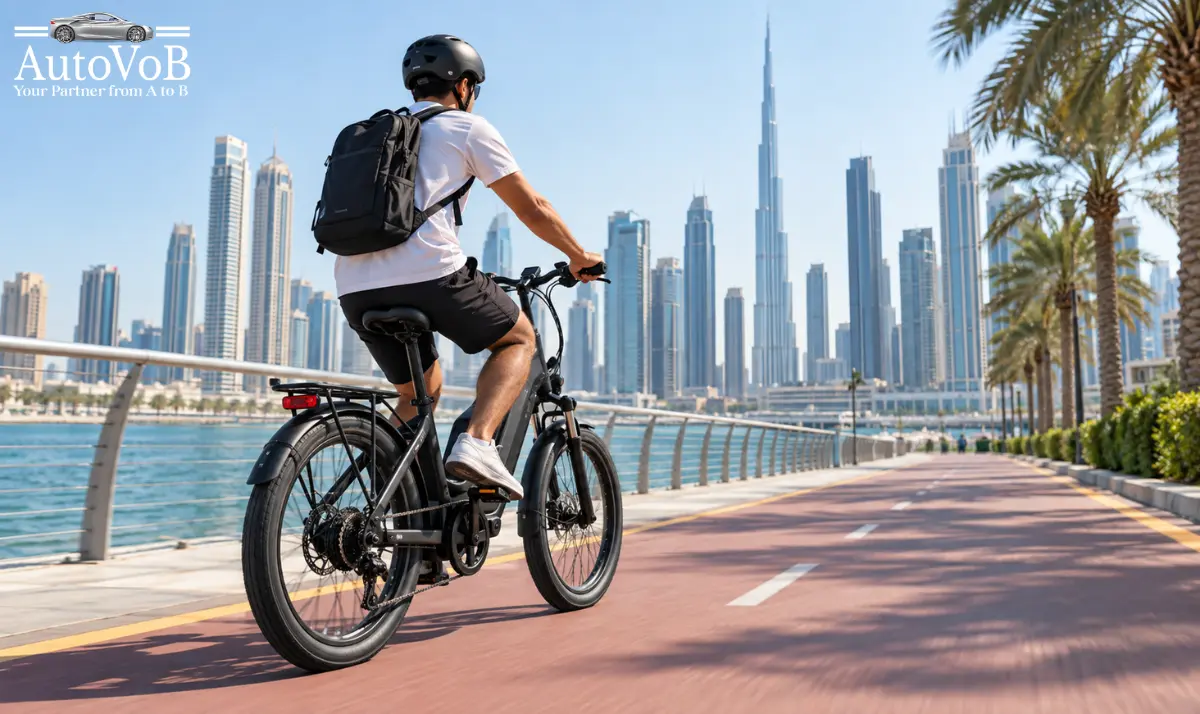
Most people shopping for an electric bicycle in the UAE start with top speed and fat tyres. That is the wrong end of the problem. The number that decides whether your bike is legal here is motor power, and a fair slice of the electric bicycle UAE market sells machines that fail the test the day you ride them home.
The rules sit in two layers. Federal Decree-Law No. 14 of 2024, in force since 29 March 2025, brought electric bikes into national traffic law under the heading of personal transportation, alongside bicycles, e-scooters and skateboards. Everything you deal with day to day is set by your emirate.
What the law counts as an electric bicycle
Dubai's Executive Council Resolution No. 13 of 2022 defines an electric bike as a vehicle with two or more wheels, fitted with an electric motor, driven by that motor or by the rider. Notice what is absent: no wattage ceiling and no speed cap in the definition itself. Dubai regulates behaviour and location instead, with the RTA setting speed limits track by track.
Abu Dhabi went the other way and put numbers on paper. The emirate's guideline for the safe use of bicycles, electric bicycles and scooters, updated in 2024 and backed by the Integrated Transport Centre, approves micromobility devices at 700 watts or less, 20 km/h or less, and 75 kg unloaded. Cross any of those lines and your bike is not authorised.
Then comes the part nobody in a showroom volunteers. Abu Dhabi's classification includes a middle tier for electric machines of 1,400 to 2,000 watts, weighing 35 to 72 kg, that top out below 60 km/h. That tier is marked not authorised and not registered. Only motorcycles capable of exceeding 60 km/h can be registered with Abu Dhabi Police. So the popular mid-power electric two-wheeler has nowhere to go. Too strong to be a bicycle, too slow to be a motorcycle.
E bike rules Dubai riders keep getting wrong
The minimum age for an electric bike or e-scooter in Dubai is 16. A helmet and a reflective vest are compulsory, for the passenger too if the bike is built to carry one. You ride on the cycle lanes the RTA designates, and you dismount and push at pedestrian crossings.
The fines are specific, and they are cheap enough that people ignore them until they stack up. Riding outside designated cycle lanes costs AED 200. Taking an e-bike onto a road with a speed limit above 60 km/h costs AED 300, as does riding in a way that endangers anyone. Riding or leaving your bike on a walking or jogging track is AED 200. Exceeding the posted limit on a cycle track is AED 100. Failing to report an accident that caused injury or damage is AED 300. Your bike also has to carry a white headlight, a red tail light, a red rear reflector, a handlebar bell and working front and rear brakes, or that is another AED 300.
Two details matter more than the amounts. Repeat the same violation inside a year and the RTA can impound the bike for 30 days, or ban you from riding it. And if the rider is under 18, the fine goes to the guardian; if it goes unpaid, the bike gets impounded anyway.
Enforcement changed in 2026. On 1 May, the RTA and Dubai Police launched a joint Personal Mobility Monitoring Unit covering cycling tracks, main roads and soft mobility zones across the emirate, with non-compliant devices impounded through Emirates Auction. Checks have been concentrated on the obvious hotspots: the Jumeirah beach track, Mohammed bin Rashid Boulevard, Dubai Water Canal, Business Bay, Dubai Marina, Al Karama and Al Mankhool. Riding a 45 km/h fat-tyre bike along a pavement used to be a gamble worth taking. It isn't any more.
For context on where all this is heading, the RTA completed 13 new cycling tracks in early 2026 as part of a 162 km master plan, and is working toward a 1,000 km network by 2030. Dubai entered the top 100 of the 2025 Copenhagenize Index, the first city in the Middle East to do it. The infrastructure is arriving faster than rider habits are changing, which is exactly why the patrols exist.
Registration: what you need and what doesn't exist
There is no number plate for an electric bicycle in the UAE, no vehicle registration, no annual inspection and no compulsory insurance. In Abu Dhabi, private owners are explicitly not required to insure their bikes, which also means you personally absorb the cost of any accident you cause. Worth thinking about before you hand one to a teenager.
What gets registered is the rider. Dubai's rider's permit is written for e-scooters and any other cycle type the RTA determines, which is why e-bike owners get contradictory answers about whether they need one. The permit is free. You log in through the RTA website, the RTA Dubai app or Dubai Now, work through the training material, pass an online test, and the permit arrives by email and SMS. Anyone holding a valid UAE or international driving licence is exempt, though you should carry that licence when you ride. One wrinkle: when the RTA expanded the service through its apps in late 2025, the published terms listed 17 and above for the permit, while the 2022 resolution still sets 16 as the minimum riding age.
My advice is unglamorous. If you don't hold a driving licence, spend the 20 minutes and get the permit. It costs nothing, and it removes the easiest AED 200 an officer can write.
Abu Dhabi has no equivalent permit for individuals. Its permits are aimed at rental operators, who must register with the ITC and meet insurance and technical conditions. Sharjah is still catching up; its Municipal Council reviewed proposals during 2026 to formally regulate bicycles, electric bikes and motorbikes across the emirate. All of this reflects the rules as published now, and any UAE authority can amend them at any time, so check before you buy rather than after.
Electric bicycle price in UAE: what to budget
Retail listings across the UAE in 2026 fall into four honest bands. Roughly AED 1,200 to AED 3,500 buys a basic imported folder. AED 3,500 to AED 7,000 gets a usable commuter. AED 7,000 to AED 12,000 gets a city or hybrid bike you can rely on for a daily ride. Beyond AED 15,000 you are into mid-drive road, gravel and mountain models, where AED 35,000 and up is normal.
Specific examples show the legal problem clearly. A fat-tyre Engwe L20 sits around AED 4,299 at UAE retailers. An ADO model marketed on a 50 km/h top speed sits around AED 4,699. That second bike is more than twice Abu Dhabi's approved speed straight out of the box. At the top, Sur-Ron Light Bee listings run from about AED 16,800 to nearly AED 20,000, and whatever the seller calls it, that is not a bicycle in any legal sense here.
Budget for heat as well. UAE retailers openly warn that summer temperatures cut usable range by 20 to 30 percent, and battery replacement is the real cost of ownership on a cheap bike, assuming the seller still stocks the pack in two years.
Also Read: Road Bike vs Mountain Bike vs Hybrid: Which Should You Buy
Best models, sorted by how you'll actually ride
For commuting, look for a city or hybrid frame with a torque sensor rather than a basic cadence sensor, a hub motor in the 250 to 500 watt range, integrated lights, mudguards and a rack. It will feel slower than the fat-tyre bikes in the same showroom and it will be far better to live with.
For weekends at Al Qudra or Nad Al Sheba, a mid-drive system from Bosch or Shimano paired with a 500 to 750 Wh battery is worth the jump to AED 15,000 and above. Brands including Thok, SUNN and Commencal are stocked locally in that bracket, with entry models around AED 19,900 and adventure builds near AED 24,700.
For anyone mixing riding with the Metro, buy a folder. Folded bicycles and e-scooters have been allowed on the Dubai Metro and Tram since October 2024, provided they are powered off and within the standard luggage size, which makes a compact e-bike genuinely useful across long cross-city trips.
Whatever you choose, ask the seller for the continuous motor rating in writing and check it against 700 watts before you pay. A shop that can't answer that question is telling you something.
FAQs
1. Do I need a permit to ride an electric bicycle in Dubai?
Dubai's rules require a rider's permit for e-scooters and any other cycle type the RTA designates, which leaves e-bikes in a grey area. The permit is free, done online through RTA channels, and anyone holding a valid UAE or international driving licence is exempt.
2. What is the minimum age for riding an e-bike in the UAE?
Dubai's Executive Council Resolution No. 13 of 2022 sets 16 as the minimum age for electric bikes and e-scooters, while RTA's permit terms list 17 and above. If a rider under 18 is fined, the guardian pays, and an unpaid fine can mean the bike is impounded.
3. How much does an electric bicycle cost in the UAE?
Basic imported folding models start near AED 1,200 to AED 3,500. Usable commuters run AED 3,500 to AED 7,000, dependable city and hybrid bikes AED 7,000 to AED 12,000, and premium mid-drive machines AED 15,000 upwards. Budget extra for a replacement battery.
4. Can I ride an electric bicycle on the road in Dubai?
Only on roads with a speed limit of 60 km/h or less, and cycle lanes take priority where they exist. Riding on a faster road carries a AED 300 fine, and walking or jogging tracks are off limits at AED 200. A helmet and reflective vest are required throughout.
5. Are high-powered e-bikes legal in Abu Dhabi?
Abu Dhabi's guideline approves micromobility up to 700 watts, 20 km/h and 75 kg unloaded. Anything stronger is unauthorised, and mid-power electric two-wheelers that stay under 60 km/h cannot be registered as motorcycles either, so they have no legal home.