ATV vs UTV vs Side-by-Side: Differences Explained
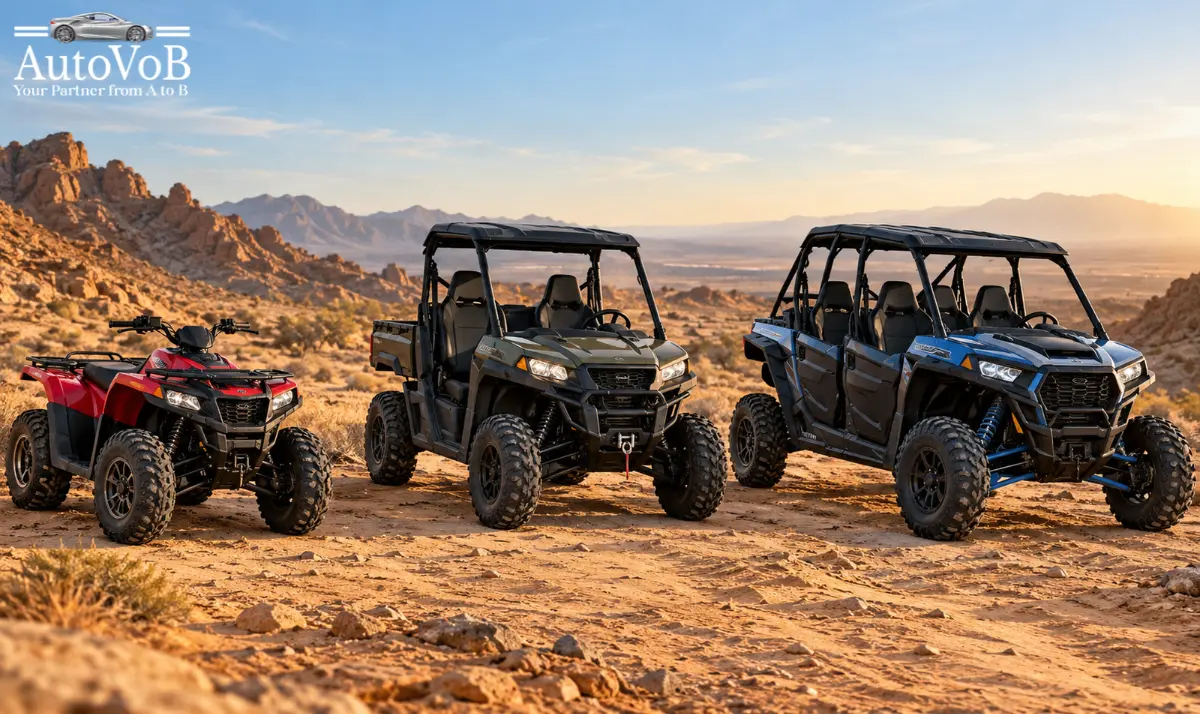
A 2026 Honda FourTrax Rancher 4x4 lists at $7,399 and carries 199 pounds across its two racks. A 2027 Polaris Ranger 1000 lists at $14,499 and carries 1,000 pounds in its box. That gap is most of the atv vs utv decision, and it has very little to do with which one is more fun.
The side-by-side part of the question is easier. For buying purposes, a side-by-side vehicle and a UTV are the same machine. What separates one model from another is the job it was built for, and that tells you more than the name on the brochure.
ATV vs UTV: who does the steering
An ATV, or quad bike, has a straddle seat and handlebars, and you steer it partly with your body. On a side slope you lean uphill. On a climb you shift your weight forward. The US Consumer Product Safety Commission (CPSC) says most ATVs are designed for one rider and that you should never carry more passengers than there are seats. Polaris and others sell two-up touring quads with a proper second seat, but a standard quad isn't one of them.
A UTV seats you like a car. The American standard for recreational off-highway vehicles lists the defining features as a steering wheel, foot pedals for throttle and brake, bench or bucket seats, a rollover protective structure, seat belts and a top speed above 30 mph. You sit inside a cage, belted in, and the machine does the balancing your body does on an ATV.
Almost everything else follows from that. The ATV is narrower, lighter and cheaper. The UTV carries more, tows more and takes a passenger, and its cage is there for the day something goes wrong.
UTV or side-by-side vehicle: same machine, different jobs
The industry uses UTV, side-by-side, ROV and multipurpose off-highway utility vehicle more or less interchangeably, and different safety standards pick different labels. When the CPSC proposed safety rules for these vehicles, it described the split that actually matters. Models built for utility have bigger cargo beds, higher load capacities and lower top speeds. Models built for recreation have smaller beds and higher top speeds.
Polaris shows both ends in one lineup. The 2027 Ranger XP 1000 has 82 hp, a 1,000-pound box, a 2,500-pound tow rating and a 1,275-pound payload, and it starts at $21,799. The RZR Pro R Boost, unveiled in August, makes 275 hp from a turbocharged 2.0-litre engine and starts at $49,999. Both are side-by-sides. Only one belongs on a farm.
At the slow end sits a machine like Kubota's diesel RTV-X1100C, which dealers list with a 24.8 hp engine, a hydraulic dump bed and a top speed of 25 mph. In my experience, people who say UTV usually mean that kind of work vehicle, and people who say side-by-side usually mean a sport model like the RZR. It's only a habit of speech, so read the spec sheet before you assume anything.
What you get for the money
Utility ATVs start at around $7,000. Polaris's new Sportsman 500 is $6,999, and Honda's Rancher 4x4 is $7,399 plus a $620 destination charge, rising to $8,649 for the version with an automatic DCT gearbox and power steering. The Rancher tows 848 pounds and is 47.4 inches wide.
A full-size utility UTV roughly doubles the price. The Ranger 1000 starts at $14,499 plus $1,195 destination, with 61 hp, a 1,000-pound box and a 2,500-pound tow rating. Add a factory cab with heat and AC and the Ranger XP 1000 Cab reaches $24,499. That cab model is 65 inches wide, so measure your gates and your trailer before you sign.
Warranties are short on both. Polaris gives most 2027 off-road models one year of factory cover, with two years on its NorthStar cab models. Honda's Rancher comes with a transferable one-year warranty.
What the safety numbers say
The CPSC's latest data put off-highway vehicles at an annual average of more than 800 deaths and about 100,000 emergency department injuries in the US. From 2018 through 2020 there were 2,448 deaths, and ATVs accounted for more than two-thirds of them. Over five years, ATVs were involved in 92% of the injuries.
Those figures aren't a per-vehicle risk rate, because far more ATVs are in use than UTVs. Regulators elsewhere have drawn their own conclusions anyway. Since 11 October 2021, Australia's quad bike standard has required every new general-use quad to carry an operator protection device, a type of rollover bar. Honda, Yamaha, Polaris and Suzuki pulled their utility quads from the market rather than fit one, and pointed farm buyers toward side-by-sides and ag bikes instead.
Ireland made helmets and training compulsory for anyone using a quad at work from 20 November 2023, the first law of its kind in the EU. In Britain, the HSE recorded 27 deaths in agriculture, forestry and fishing in 2024/25, and seven of them were connected to ATVs.
My view is that an ATV is a perfectly good tool for a trained adult in a helmet who rides alone. It's the wrong machine for anyone who'll carry a passenger, a child or a heavy load across a slope.
Picking the best UTV for farm work
Buy for the box, the hitch and the cab, and ignore horsepower. A farm UTV spends its life at walking pace carrying fence posts, feed and tools. The Ranger 1000's 1,000-pound box and 2,500-pound tow rating cover most of that, and at $14,499 it's where I'd start a shortlist.
A diesel like the Kubota RTV-X1100C makes sense if your yard already runs on diesel, because one fuel tank can feed everything. Dealers list it with a 1,102-pound bed and a 1,300-pound tow rating, so it carries slightly more in the bed than the Ranger 1000 but tows about half as much, and it tops out at 25 mph. A hydraulic dump bed earns its price if you move gravel, manure or firewood. A heated cab earns its price if you work through winter.
Skip the sport models. A long-travel RZR is a trail machine, and its smaller bed and higher speed do nothing for farm work. Keep an ATV if your tracks and gates are too narrow for a 65-inch machine, or if you mostly check stock and need to hop on and off all day. The best UTV for farm use is the one that fits your narrowest gate and your heaviest regular load.
Also Read: Dune Buggies and ATVs in UAE: Buying and Legal Guide
Kids, passengers and public roads
The CPSC says riders under 16 should drive only age-appropriate youth models, never adult ones. Under the industry standard, youth ATVs are graded Y-6+, Y-10+, Y-12+ and T, the last for riders 14 and up, with speed limiters fitted at the factory. A Y-6+ model is restricted to 10 mph as delivered, and no ATV is designed for a child under six. In Britain, carrying a passenger on a sit-astride ATV breaks the law.
The CPSC also says to stay off paved roads and never ride on public roads except to cross them where the law allows. Road rules for UTVs vary widely between countries and, in the US, between states, so don't assume a registration in one place carries over to another.
The details here reflect current information from manufacturers, the CPSC, Australia's consumer regulator, Ireland's Health and Safety Authority and Britain's HSE as of October 2026. Governments can change helmet, training, age, registration and road-use rules at any time, so check the current position with your local authority before you buy or ride.
If I were equipping a working farm tomorrow, I'd buy a utility UTV for the hauling and keep one ATV for the jobs where width matters, with a helmet hanging on the handlebars. A side-by-side with a cage and seat belts forgives mistakes that an ATV punishes, and on a farm the small mistakes come every day.
FAQs
1. What is the difference between an ATV and a UTV?
An ATV has a straddle seat and handlebars and is usually built for one rider. A UTV, also called a side-by-side, has a steering wheel, foot pedals, bench or bucket seats, a rollover structure and seat belts, so it can carry a passenger and far more cargo than an ATV.
2. Is a UTV the same as a side-by-side vehicle?
Yes, for most buyers. UTV, side-by-side, ROV and multipurpose off-highway utility vehicle describe the same layout. The useful split is between utility models with big beds and lower top speeds, like the Polaris Ranger, and sport models with small beds and high speeds, like the RZR.
3. What is the best UTV for farm work?
Pick a utility UTV with a big box, a strong hitch and a dump bed, not a sport model. The 2027 Polaris Ranger 1000 starts at $14,499 with a 1,000 lb box and 2,500 lb tow rating. A diesel Kubota RTV-X1100C suits farms that already run diesel tractors and pumps.
4. Are ATVs more dangerous than UTVs?
CPSC data shows ATVs were linked to more than two-thirds of the 2,448 US off-highway vehicle deaths from 2018 to 2020 and 92% of injuries over five years. Far more ATVs are in use, so that isn't a per-vehicle rate, but UTVs add a rollover structure and seat belts.
5. Can children ride ATVs or UTVs?
The CPSC says riders under 16 should drive only age-appropriate youth models, never adult machines. Youth ATVs are graded Y-6+, Y-10+, Y-12+ and T for ages 14 and up, with factory speed limiters. No ATV is designed for a child under six, and local laws may set stricter limits.
For more useful automotive tips and updates, stay tuned to AutoVoB Blogs.