CVT vs DCT vs Torque Converter: Transmission Types Explained
Most people choose a car by its screen size and seat trim, then spend five years living with a gearbox they never thought about. That's backwards, because the transmission decides how the car pulls away from a light, how it behaves in a jam, and how big your repair bill gets at 120,000 km.
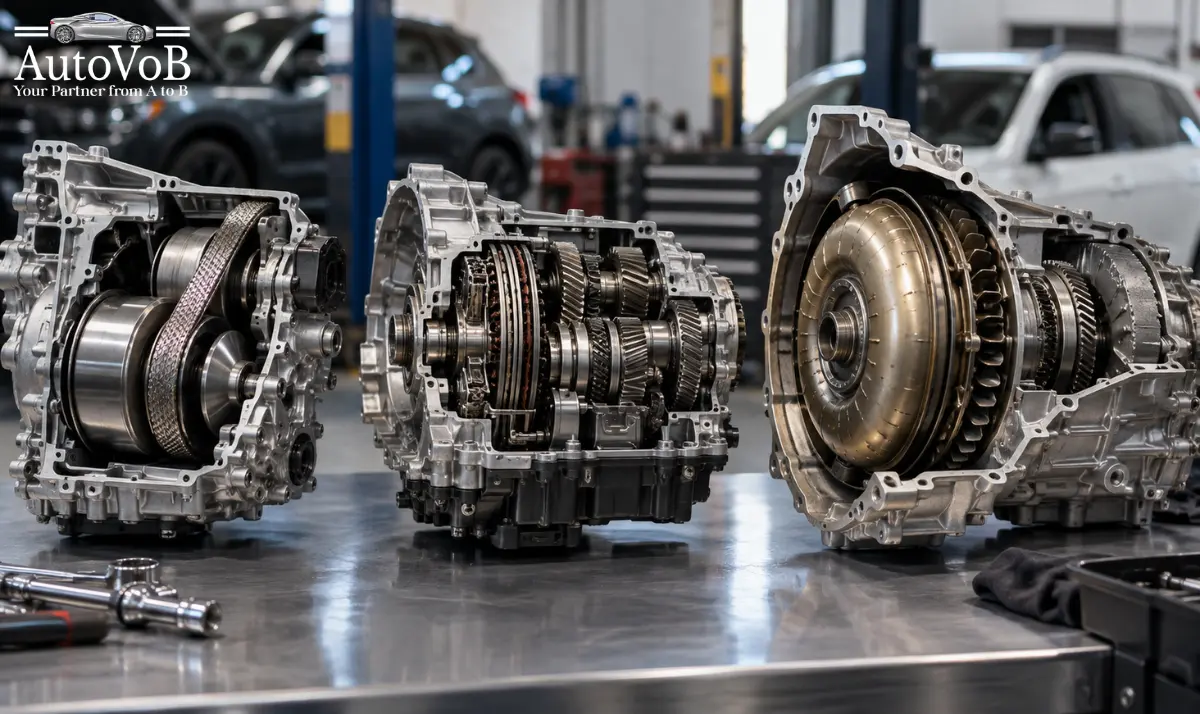
You'll meet three automatic designs on a showroom floor: the CVT, the dual-clutch (DCT), and the conventional torque converter automatic. The CVT vs DCT debate gets most of the attention online, yet the old torque converter still beats both in a lot of real-world driving. Here's how each one works and where each one falls short.
How a CVT Works, and Why It Feels Strange
A continuously variable transmission has no fixed gears. It uses two cone-shaped pulleys joined by a steel belt or chain. As the pulleys change width, the belt rides higher or lower on each one, so the ratio shifts smoothly across a continuous range. The engine can sit at its most efficient rpm while the car gathers speed.
That's the appeal: good fuel economy and no shift shock. It's also the complaint. Floor it on a highway on-ramp and the revs jump and hang there while the speed catches up. Owners call it the rubber-band feel, and many manufacturers now program fake shift points into their CVTs to disguise it.
Toyota took a smarter route. Its Direct Shift-CVT adds a physical launch gear for pulling away from a stop, then hands over to the belt once the car is moving. Taking the heaviest load off the belt let Toyota shrink the pulleys and narrow the belt angle from 11 to 9 degrees. The company claims a 6% fuel economy gain over its previous transmission. Drive one back to back with an older CVT and you'll feel the difference at the first set of lights.
The Reliability Question
CVTs earned their bad reputation honestly, and Nissan is the reason most buyers have heard of the problem. In the US, Nissan settled a string of class actions over CVTs in models including the Altima, Sentra, Versa, Rogue and Pathfinder. Those settlements extended transmission coverage from 60 months or 60,000 miles to 84 months or 84,000 miles. Owners in those cases described shaking, shuddering and overheating. The latest settlement covers the 2015 to 2018 Murano and the 2016 to 2018 Maxima.
My view is simple. A modern, well-engineered CVT that gets its fluid changed on schedule is a sensible ownership proposition. A used CVT with no service history is a gamble I wouldn't take at any price.
How a DCT Works: Two Clutches, One Very Fast Shift
A dual-clutch transmission is essentially two manual gearboxes sharing one case, run by a computer. One clutch handles the odd gears (1, 3, 5) and the other handles the even gears (2, 4, 6). While you're in third, the computer has already lined up fourth on the other shaft. The shift itself is one clutch letting go as the other bites. That's why a good DCT changes gear almost instantly and wastes very little power doing it.
On a winding road, nothing else in this comparison feels as sharp. In stop-and-go traffic, it's a different car. At crawling speeds a DCT has to slip its clutches the way you would with a manual. That's where you feel hesitation, low-speed jerkiness and, in the worst cases, shudder. Anyone who has worked a service desk has heard the same complaint from DCT owners stuck in rush hour.
Wet Versus Dry Clutches
Most buyers never ask about this, and it matters more than the badge on the boot. A wet DCT runs its clutches in an oil bath, which carries heat away and lets the gearbox handle more torque. The trade-off is a small efficiency loss from pumping all that oil. A dry DCT keeps oil away from the clutches, which makes it lighter and slightly more fuel efficient, but it copes worse with heat. Repeated launches on a hill with a heavy load are exactly the conditions that push a dry clutch too hard.
Ford's PowerShift is the cautionary tale. The dry-clutch DPS6 unit in the 2011 to 2016 Fiesta and 2012 to 2016 Focus drew lawsuits alleging slipping, bucking and jerking. The US settlement that followed covered close to 1.5 million cars. If you live somewhere hot with heavy traffic, and a Gulf summer ticks both boxes, I'd steer clear of small dry-clutch units. A wet DCT, like the ones Volkswagen fits to the Golf GTI and Golf R, is a much safer bet for daily use.
The Torque Converter Automatic: Old Design, Still the Benchmark
The conventional automatic uses a fluid coupling instead of a clutch. An impeller driven by the engine throws transmission fluid at a turbine connected to the gearbox. A stator between them redirects the returning fluid, which multiplies torque at low speeds, by up to 2.5 times. It's why a torque converter car pulls away from a standstill so cleanly, with no clutch to slip and nothing to judder.
The old knock was that fluid slip wasted fuel. Modern units fix that with a lock-up clutch that mechanically joins the engine to the transmission once the car is moving steadily. Add more gears, and most of the efficiency gap disappears.
ZF's 8HP shows how far the design has come. ZF rates the family for engines from 220 to 1,000 Nm, and the mid-size 8HP70 weighs 87 kg including oil. It shifts quickly enough that a well-known engineering reviewer mistook it for a dual-clutch, and you'll find it in Jaguar, BMW and Range Rover models.
The downsides are weight, complexity and a big bill if it ever needs a rebuild. Maintenance is the other catch. Some makers sell these gearboxes as sealed for life. Transmission specialists still recommend a fluid service around every 60,000 miles, or roughly 100,000 km, and sooner under severe use. In my experience, a torque converter automatic that gets that care is the least dramatic of the three to own.
Also Read: Virtual Gear Shifting In Cars, What It Is And Why It Matters
CVT vs DCT vs Torque Converter: Which One Fits Your Driving?
Match the gearbox to how you actually drive, not to the brochure.
If most of your driving is commuting in a small or mid-size car and fuel cost is your priority, a modern CVT makes sense, ideally one with a launch gear. Keep the service records, and don't buy a CVT car second-hand without them.
If you enjoy driving and spend a lot of time on open roads, a DCT gives the quickest, most connected shifts of the three. Pick a wet-clutch unit if you can, especially in a hot climate.
If you sit in heavy traffic, tow, carry a full family load, or want a bigger engine, the torque converter is the one I'd pick. It handles heat, crawling and high torque with the least fuss.
Whatever you shortlist, test drive it the way you'll use it. Crawl through traffic, creep up a parking ramp, and pull away hard from a stop on a slope. Those three minutes tell you more than any spec sheet.
One caveat on the legal side. The Nissan and Ford settlements mentioned here applied to vehicles sold in the US. Warranty terms differ by country and can be revised by manufacturers or the country's government at any time, so this information reflects current data only. Confirm current coverage with your local dealer before you buy.
The CVT vs DCT question has no universal winner, and anyone who tells you otherwise is selling one of them. Each design is good at one job and weaker at another. Know which job your car will be doing most days and check how that specific gearbox has held up in owners' hands. Do that, and you'll avoid the most expensive surprise in car ownership.
FAQs
1. What is the main difference between a CVT and a DCT?
A CVT uses two pulleys and a belt to vary the ratio smoothly with no fixed gears, which favours fuel economy. A DCT uses two computer-controlled clutches, one for odd and one for even gears, so it shifts very quickly. The CVT is smoother, the DCT sharper.
2. Are CVT transmissions reliable?
Many can be, as long as the fluid is changed on schedule. Nissan settled several US class actions over CVT shudder and overheating, extending coverage to 84 months or 84,000 miles on models like the Rogue and Altima. Avoid used CVTs with no service history.
3. What is the difference between a wet and a dry DCT?
A wet DCT runs its clutches in oil, which removes heat and handles more torque, at a small efficiency cost. A dry DCT is lighter and slightly more efficient but copes worse with heat, so it suits low-torque cars better than hot climates and heavy stop-and-go traffic.
4. Why do many drivers still prefer a torque converter automatic?
A torque converter multiplies engine torque at low speed through fluid, so it pulls away smoothly without slipping a clutch. Modern units add a lock-up clutch and eight or more gears, which closes most of the fuel economy gap and makes them very durable in heavy traffic.
5. Which transmission is best for heavy traffic and hot weather?
For heavy traffic, heat or towing, a torque converter automatic is the safest choice. A DCT, ideally wet-clutch, suits drivers who want quick shifts on open roads. A modern CVT, especially one with a launch gear like Toyota's, suits economical everyday commuting.
For more such engaging reads, keep visiting AutoVoB Blogs.