Turbocharger vs Supercharger: Differences Explained
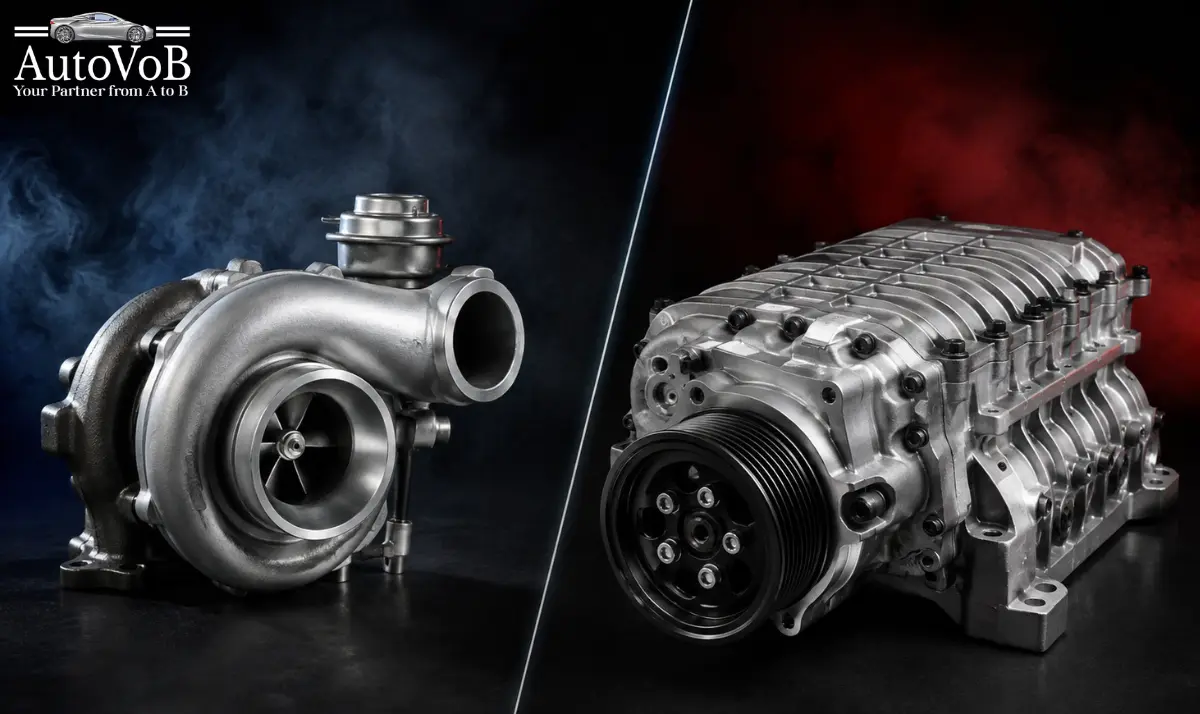
Two versions of the same pickup settle this argument faster than any spec sheet. The 2026 Ford F-150 Raptor runs a twin-turbo 3.5-litre V6 rated at 450 hp. The Raptor R runs a supercharged 5.2-litre V8 rated at 720 hp and costs about $32,000 more. Both are forced induction, both shove extra air into the cylinders, and both are sold by the same company in the same showroom. The turbocharger vs supercharger decision comes down to what you want the engine to feel like and what you're prepared to pay for that feeling in fuel, money and maintenance.
Both devices are just air pumps
An engine can only burn as much fuel as it has oxygen for. A naturally aspirated engine takes whatever air atmospheric pressure pushes into the cylinder. Forced induction compresses that air first, so more oxygen fits into the same space, more fuel goes in with it, and the engine makes more power without getting bigger. A turbocharger and a supercharger both do this. The only real difference is what spins the pump.
How a turbocharger works
Exhaust gas leaving the cylinders spins a turbine wheel. A shaft connects that turbine to a compressor wheel on the intake side, which pressurises the air heading into the engine. Garrett, one of the biggest suppliers in the business, rates its turbine wheels for speeds up to 350,000 rpm in gas temperatures reaching around 1,900°F, roughly 1,040°C. That's a small metal wheel living in the hottest part of the car and spinning faster than anything else you own.
The appeal is obvious. A turbo runs on energy that would otherwise disappear out of the tailpipe. It isn't free, because the turbine creates backpressure in the exhaust, but it's close enough that emissions engineers and finance departments both approve.
The cost is lag. The turbine needs exhaust flow before it can make boost, and exhaust flow needs throttle. With a small turbine wheel and a twin-scroll housing, that delay is now a few tenths of a second. On older large-turbo engines it could stretch past a second, then arrive all at once, which is how early turbo road cars earned their reputation for biting drivers mid-corner.
How a supercharger works
A supercharger is bolted to the engine and driven by a belt or gear off the crankshaft. If the engine is turning, the blower is turning. Boost is available the moment the throttle opens because the compressor speed is locked to engine speed.
Roots blowers sit on top of the engine and push air down into the intake. Cadillac's CT5-V Blackwing uses an Eaton TVS R1740, a four-lobe positive-displacement unit, to make 668 hp from a 6.2-litre V8. The Ford Mustang GTD uses a bigger TVS R2650 with a smaller pulley for 815 hp. Twin-screw units work on a similar principle with tighter rotor tolerances. Centrifugal superchargers look like a turbo compressor on a belt and build boost as revs rise, so they feel closer to a turbo than to a Roots blower.
Driving that pump costs power. Supercharger suppliers put the drain somewhere between 15 and 60 hp on a typical street setup, depending on blower size and pulley ratio. That loss is already subtracted from the figure in the brochure.
Turbocharger vs supercharger: the differences you actually feel
Response is the clearest split. A supercharged V8 answers your right foot immediately at 1,200 rpm, and that never gets old. Modern turbo engines counter with small, fast-spooling turbos and torque peaks that arrive by 1,500 rpm, which produces a broad flat wave rather than a sharp hit. Different sensations, similar results at legal speeds.
Fuel consumption favours the turbo, at least when you behave. The whole downsizing strategy depends on a small turbo engine loafing along off boost most of the time. Drive it hard and the advantage evaporates quickly, which is why so many downsized turbo cars miss their official economy figures in real use. A supercharger consumes crank power whenever the engine is running, so its penalty is constant.
Heat is a problem for both, in different ways. Turbos concentrate extreme temperature in one component that needs oil and often coolant to survive. Superchargers dump their heat into the intake charge, which is why performance blowers sit on top of an intercooler. In hot climates, both systems lean harder on the cooling package than most buyers realise.
Then there's noise. A Roots blower whines. A turbo whistles and sighs. Neither is objectively better, but plenty of people have chosen a car on that basis alone, and there's nothing wrong with that.
Why nearly every new car has a turbocharger
Emissions and fuel economy rules pushed manufacturers toward smaller engines that still make big-engine torque, and the turbo does that job cheaply. GM sells its full-size Silverado with a turbocharged 2.7-litre four. Ford's F-150 offers four different turbo engines. Stellantis retired the Hemi V8 and gave the reborn Charger a twin-turbo Hurricane inline-six, and that petrol Sixpack outsold the electric Charger by roughly seven to one in the first quarter of 2026.
The supercharger keeps losing ground. Cadillac has confirmed the CT5-V Blackwing ends production after the 2026 model year with no confirmed supercharged replacement. Lotus launched a new Emira 420 Sport with a turbocharged four making 414 hp, above the 400 hp of the supercharged Toyota-sourced V6 the car started with. Emissions and tax rules also vary by country and get revised regularly, so check what applies in your market before assuming an engine stays compliant or cheap to register.
Where superchargers still make sense
Instant torque from a large-displacement V8 is a product in its own right, and buyers pay for it. The Mustang GTD makes 815 hp and 664 lb-ft from a supercharged 5.2-litre V8 and starts around $325,000. The Raptor R uses a version of the same engine. The Durango SRT Hellcat still runs a 710 hp supercharged 6.2. Stellantis restarted production of that engine at its Dundee plant in August 2025, and at its 2026 investor day confirmed a Charger SRT Hellcat with more than 700 hp is on the way.
Off-road and drag racing favour the blower for the same reason: power that appears the instant you ask, with no waiting for exhaust flow to build.
The compromise most manufacturers picked
Mercedes-AMG solved lag with electricity rather than a belt. The SL 43 uses the M139 two-litre four with an electric exhaust gas turbocharger, a slim 48-volt motor mounted on the turbo shaft that spins the turbine to as much as 170,000 rpm before exhaust gas takes over. The technology came from the AMG Formula 1 programme, and the result is 375 hp with almost no measurable lag.
Twincharging, where a supercharger handles low revs and a turbo takes over up top, had its moment with Volkswagen's 1.4 TSI and Volvo's Drive-E engines. It worked, but it added cost and complexity that electric assistance now delivers more cleanly.
Also Read: Car Engine Parts and Their Functions
What this means when you buy or service one
If you own a turbo car, oil is the component that matters most. Use the manufacturer's specified full synthetic and change it on time, not late. After a hard drive, heat soaks back from the turbine housing into the centre bearing and can bake the residual oil into carbon deposits, which block the oil feed and eventually destroy the turbo. Garrett tests for exactly this in its own durability programme. Thirty to sixty seconds of idle before shutdown costs nothing and prevents a very expensive repair, and it matters more in hot weather than in cold.
Buying used, start the engine cold and watch for blue smoke, listen for a change in the turbo's whistle, and check the intercooler piping for oil. On a supercharged car, the wear items are mechanical rather than thermal: the drive belt, tensioner, snout bearing and coupler, plus the coolant pump on water-to-air intercooled units. A rattle at idle usually means a worn coupler.
Either way, ask whether the car has been remapped. Both systems tolerate more boost than the factory asks for, and both fail early when someone chases numbers without upgrading fuelling and cooling to match.
Anyone shopping for a normal car in the next few years will be shopping for a turbocharger, whether they wanted one or not. Superchargers survive at the top of the market and in the aftermarket, where the belt-driven punch is the entire point and fuel economy is somebody else's problem. If you want one from a factory, the shortlist gets shorter every model year.
FAQs
1. Which is better, a turbo or a supercharger?
Neither wins outright. A turbocharger uses waste exhaust energy, so it returns better fuel economy and leaves more tuning headroom. A supercharger is belt-driven and gives instant boost with no lag. Choose a turbo for daily driving and a supercharger for immediate low-rpm punch.
2. What is turbo lag, and does it still exist?
Turbo lag is the pause between opening the throttle and the turbine spinning fast enough to build boost. Smaller turbine wheels, twin-scroll housings and 48-volt electric assistance have cut it to a few tenths of a second, so most drivers rarely notice it in normal traffic.
3. Do superchargers use more fuel than turbochargers?
Generally yes. A supercharger draws power from the crankshaft whenever the engine runs, roughly 15 to 60 hp on street setups. A turbocharger runs on exhaust energy that would otherwise be wasted, which is why manufacturers use turbos to meet tightening fuel economy targets.
4. Which one needs more maintenance?
A turbocharger demands strict oil discipline, because heat soaking back after shutdown can bake oil into deposits that block the bearing feed. A supercharger avoids that heat but adds a belt, tensioner, snout bearing and sometimes a coolant pump. Both last well when serviced properly.
5. Can you add a turbocharger or supercharger to a standard engine?
Yes, though the engine needs supporting work: fuelling, cooling, engine management and often stronger internals. Bolt-on supercharger kits are usually simpler to fit than turbo systems. Check your local inspection and modification rules first, since they differ by country and can change.
Stay connected with AutoVoB blogs for more informative updates.
Your global destination to buy and sell all types of vehicles, AutoVoB.