Toyota Fortuner vs Ford Everest: Car Comparison
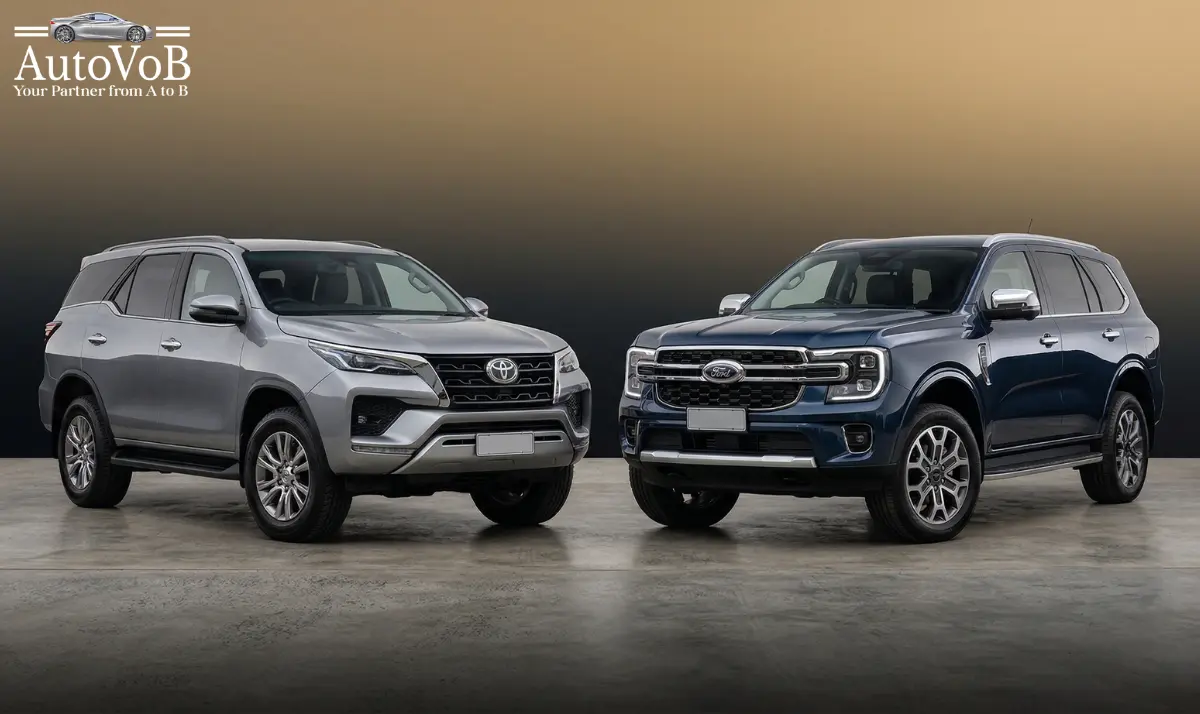
Toyota Fortuner and Ford Everest sit in the same niche: ladder‑frame, 7‑seat SUVs built off pickup platforms, meant to tackle family duties during the week and dunes on the weekend. Both are serious machines, not soft crossovers, but they deliver that toughness in different ways.
Think of the Fortuner as the conservative, proven choice and the Everest as the more modern, tech‑loaded alternative.
Engine, performance and fuel economy
The Fortuner in the UAE typically comes with two petrol options: a 2.7‑liter four‑cylinder and a 4.0‑liter V6, both with automatic gearbox and all‑wheel drive. Power ranges roughly from about 164 hp in the 2.7 to around 235 hp in the V6, with torque up to 376 Nm. Real‑world fuel economy is in the 7–8 km/l ballpark depending on engine and driving.
The latest Everest internationally is built around modern turbo engines, usually a 2.0‑liter bi‑turbo diesel or a 3.0‑liter turbo‑diesel V6, paired with a 10‑speed automatic. Power sits around 154–184 kW with 500–600 Nm of torque, which feels strong in everyday driving and especially while towing. Fuel consumption is more efficient on paper, with claimed figures from roughly 7.1 to 8.5 l/100 km depending on engine and drivetrain.
In simple terms:
- Fortuner: naturally aspirated petrol, simpler, slightly thirstier, very predictable.
- Everest: turbo‑diesel focus, more torque, stronger towing, better efficiency if you rack up highway miles.
Ride comfort and interior feel
The Fortuner cabin is familiar Toyota territory: straightforward layout, practical storage, and decent material quality for the segment. Higher trims add leather, soft‑touch surfaces, powered seats and a more premium feel, but it still leans functional rather than luxurious. Ride comfort is firm, as you would expect from a ladder‑frame SUV, but it is well controlled once you are up to speed.
The Everest pushes more toward a passenger‑car‑like cabin. You get a wider dash, more modern design, and in many markets a large vertical touchscreen, digital instrument cluster and a more hushed cabin. The ride tends to be more settled and refined, especially on rough roads, thanks to Ford’s tuning and suspension setup.
If you care about a premium feel and refinement, Everest usually edges ahead. If you prefer simple, durable and easy‑to‑live‑with, Fortuner’s layout makes a lot of sense.
Space, practicality and family use
Both SUVs offer three rows and seven seats. The Fortuner’s dimensions are roughly 4795 mm long, 1855 mm wide and 1835 mm high, with ground clearance around 220–225 mm. Boot space is usable with the third row up and becomes properly generous once you fold it.
The Everest is slightly longer and wider, at about 4914 mm long and 2207 mm wide, with similar height. That extra size translates into better shoulder room and a bit more luggage space, especially with the third row folded. Ford has also focused on making the third row more adult‑friendly in terms of access and headroom.
Family perspective:
- Fortuner: plenty of space for daily UAE use, school runs and weekend trips, but third row is best for kids or short hops.
- Everest: more generous cabin, slightly more comfortable if you regularly carry six or seven people.
Off‑road capability and towing
Both of these are proper body‑on‑frame SUVs with real off‑road credentials. The Fortuner offers all‑wheel drive, good approach/departure angles, low‑range gearbox in 4x4 trims and healthy ground clearance, making it a common sight off‑road across the region.
Everest, especially in its 4x4 variants, is a serious dune and trail tool, often with selectable drive modes, locking rear differential and strong towing capacity up to around 3500 kg. The combination of high torque from the turbo‑diesel engines and the 10‑speed gearbox makes it effortless under load.
If your life involves frequent dune bashing, towing boats or trailers and long‑distance trips with cargo, Everest’s torque and towing numbers give it a real edge. If you want a weekend‑capable off‑roader that is proven and easy to service anywhere, Fortuner is still a very smart pick.
Tech, safety and features
On the tech front, both models have stepped up, but Everest feels more current.
Fortuner brings essentials like touchscreen infotainment, smartphone connectivity, multiple airbags, stability control and available driver‑assist features depending on trim and market spec. You get what you need, but the software and screen design feel more traditional.
Everest tends to pack in larger screens, more connected features, and a broader suite of driver assistance tech such as adaptive cruise, lane‑keeping aids and advanced collision avoidance in higher trims. That makes it feel more like a modern family SUV than an old‑school truck.
If gadgets, big screens and driver‑assist systems matter to you, Everest is usually the more satisfying choice.
Reliability, ownership and resale
This is where Fortuner earns its reputation. Toyota’s reliability in the GCC is almost a cliché at this point, and Fortuner benefits from simple naturally aspirated engines, wide service coverage and plenty of parts availability. That shows up in strong resale values and high demand on the used market.
Everest’s latest generation is much improved and has gained a good reputation in many markets, but in our region it still cannot match Toyota’s resale strength and brand perception for long‑term durability. It compensates with stronger warranties from dealers and more generous standard equipment, which can make total ownership cost competitive if you keep the car for a few years.
If you think in 10‑year horizons and care deeply about resale and hassle‑free ownership, Fortuner is the safer long game. If you plan to keep the car for, say, 3–5 years and want more tech per dirham, Everest is worth serious consideration.
New Fortuner and Everest prices in UAE
New Toyota Fortuner prices in the UAE currently start from around AED 127,900–128,900 for the 2.7 EXR base variant. Mid‑range 4.0 GXR versions are roughly AED 150,000–155,000 depending on dealer and equipment. The top 4.0 VXR trim goes up to about AED 173,900.
On classifieds, new or near‑zero‑km 2025 Fortuner listings in Dubai often sit in a similar band, with EXR 2.7L units around AED 109,999–130,000 and high‑spec VXR 4.0L examples around AED 150,000–160,000 depending on dealer offers and optional packages.
The Ford Everest 2025 range in the UAE is listed from about AED 158,000 at the lower end, with mid‑spec variants around AED 168,000 and top trims close to AED 199,395. That places Everest generally above a Fortuner 2.7 and in line with or slightly higher than a fully‑loaded Fortuner V6, depending on spec and discounts.
Used Fortuner and Everest prices in UAE
On the used market, Fortuner holds value well but still gives you a spread of prices. High‑kilometer older models can dip into the 50,000–70,000 AED range, while cleaner, newer cars with low mileage and warranty can list from the high 90,000s up to around 140,000+ AED for late‑model 2024–2025 examples. For nearly‑new Fortuner under 20,000 km, asking prices often sit near new‑car money once you factor in dealer benefits, roughly from 110,000 to 150,000+ AED depending on engine and trim.
For Ford Everest, UAE classifieds and dealer data show used 2024 units starting around AED 109,899 and going up to about AED 186,000, with average prices near AED 137,000. Broader used‑Everest data across recent years suggests 2025 models in the region typically range from around AED 90,000 at the lower end up to roughly AED 280,000 for high‑spec or special‑use variants, depending on mileage and condition. That wide span reflects different trims, engines and how heavily the cars were used.
As always, exact used prices move with mileage, service history, accident records and how urgently the seller wants to deal.
Also Read: Nissan Patrol vs Toyota Land Cruiser: Which SUV Rules UAE Roads
So which one should you buy in the UAE
If your priorities are reliability, easy ownership, strong resale, and a petrol engine that any workshop understands, the Toyota Fortuner is the smarter bet. It might feel a bit more old‑school, but that is exactly why so many people buy it and never look back.
If you want more torque, a more refined ride, newer tech and you are okay with slightly higher entry pricing and a brand that does not quite match Toyota on resale, the Ford Everest will make you happier every time you drive it.
For more such car comparison blogs, keep following AutoVoB blogs.