Timing Belt vs Timing Chain: What Buyers Should Check
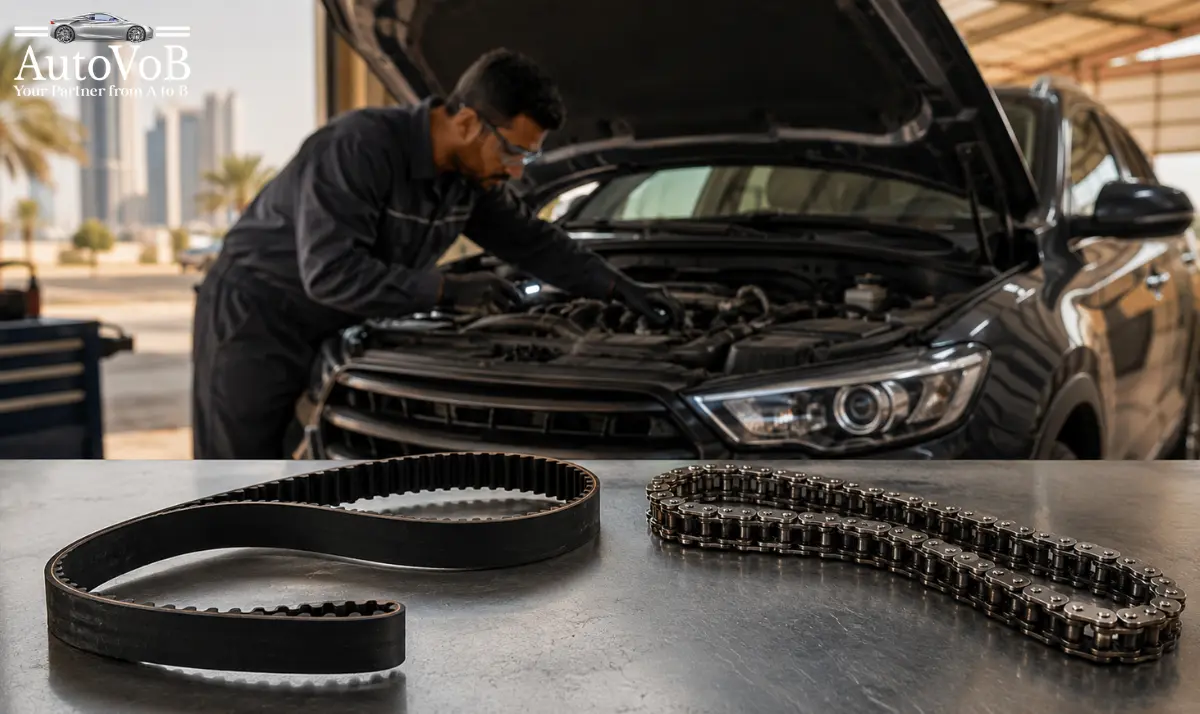
A timing belt is a consumable with an expiry date. A timing chain is not, at least on paper. The timing belt vs timing chain question decides whether you inherit a service bill worth thousands of dirhams in your first month of ownership or nothing at all, and almost nobody raises it during a test drive.
Sellers rarely volunteer it. Most listings never mention it. In a market where cars sit in 45 degree heat for five months a year, it deserves more attention than the paint correction the seller is so proud of.
What actually separates the two
Both parts do one job: keep the crankshaft and camshafts spinning in exact sync so the valves open and close at the right instant. Get that wrong by a few degrees and the engine runs rough. Get it wrong by a tooth and the pistons meet the valves.
The difference is material and position. A belt is reinforced rubber, usually behind a plastic cover on the outside of the engine, dry and reachable. A chain is metal, sits inside the engine, and runs in oil. Belts are quieter, cheaper to build, and straightforward to replace. Chains last longer but cost far more when they do go wrong, because reaching them means opening up the engine.
That is the whole trade. Everything else is detail.
Timing belt vs timing chain in Gulf heat
Rubber ages on a calendar, not just an odometer. Heat cycles and high under-bonnet temperatures break down the compound whether the car covers 40,000 km a year or sits in a tower car park in Sharjah. Technicians regularly pull cracked, delaminating belts off cars with well under 60,000 km on them, purely because the belt has been in there for nine years.
This is why manufacturers publish two numbers, distance and time, then add whichever comes first. Typical intervals fall between roughly 96,000 and 160,000 km, or five to ten years. Here, the time figure is usually the one that catches people out.
A tidy low-mileage car with 45,000 km and a 2016 build date is not a car with a fresh belt. It is a car with a ten-year-old belt and no wear to show for it. Those are the ones that snap on Sheikh Zayed Road.
How to find out which one you are buying
Open the owner's manual to the maintenance schedule. If timing belt replacement appears with a mileage or age beside it, the car has a belt. If timing is not listed as a service item at all, it almost certainly has a chain.
Do not guess by badge. Toyota's 4.0 litre V6, the 1GR-FE used in Prado and Fortuner, runs a chain. The 4.7 litre V8 in the Land Cruiser 100 and Lexus LX 470 runs a belt due at around 145,000 km. Same manufacturer, opposite answer. Honda's V6 engines in the Accord, Odyssey and Pilot use belts on a 105,000 mile schedule, roughly 169,000 km, or seven years, while most four-cylinder Hondas use chains.
Any franchised dealer can confirm the answer from the VIN in a couple of minutes. Ask before you negotiate, not after you have paid.
The belt cars worth checking twice
Most modern petrol engines are interference designs, which means there is no clearance between a fully open valve and a piston at top dead centre. When the belt goes, the damage is immediate and internal. Bent valves at minimum, and UAE workshops quote engine repair bills above AED 10,000 once the head comes off. A belt service costs a fraction of that, which is the entire argument for doing it on time.
Ask for the invoice, not the story. Sellers will tell you the belt was done. A proper job lists the belt, the water pump, the tensioner and the idler pulleys, along with the odometer reading and a date. If the water pump is missing from that list, the job was half done, because the pump is usually driven by the same belt and replacing it later means paying the same labour twice.
Be equally wary of a suspiciously cheap belt change with a no-name kit. A budget belt in a hot climate is not a saving, it is a delayed bill.
Chains break the rules too
The idea that a chain is fit and forget is marketing more than engineering. Chains stretch, and their tensioners and plastic guides wear.
Volkswagen and Audi's EA888 2.0 TSI in its first two generations, broadly 2008 to 2013, has a well-documented tensioner fault that could lose pressure with the engine off and let the chain jump on the next cold start. VW revised the design from around 2013 and later cars have a much better record. The smaller EA111 1.2 and 1.4 TSI engines developed a reputation for chain stretch before 100,000 km. BMW's N47 diesel put the chain at the back of the engine against the gearbox, so a replacement is an engine-out job costing several times what a belt service would. Mercedes M271 four-cylinder units are known to stretch chains where oil changes were pushed too far.
The tell is a metallic rattle for the first one to three seconds after a cold start, then silence. On a car you are inspecting, that is not a quirk. That is a negotiation or a walk-away.
Oil is the single biggest variable in chain life. Correct specification, changed on time. Short city trips and heat both work against you here, so shorter oil intervals than the book allows are money well spent.
Wet belts are the modern trap
Some engines run the timing belt inside the engine, submerged in oil. Ford's 1.0 EcoBoost three-cylinder and the Stellantis 1.2 PureTech used in various Peugeot, Citroen and Opel models are the two everyone argues about.
The design works until the oil degrades, at which point the belt can shed material that blocks the oil pickup and starves the engine. You cannot inspect it without stripping the front of the engine, which means a visual check is worthless. Ford recalled around 140,000 vehicles in the United States in 2024 over a related oil pump belt issue, and Stellantis introduced customer support programmes for affected PureTech engines in some markets. Ford's own published interval for the cam belt ran as long as ten years or 150,000 miles, while independent specialists commonly advise closer to seven or eight years and 80,000 miles. Peugeot has cited six years or 62,000 miles on some affected 1.2 litre cars.
Coverage and recall programmes differ by market, so do not assume a UK or US scheme applies to a GCC car. Check with the local distributor using the VIN.
Also Read: Electric vs Hydraulic Power Steering: Which System Is Better?
What this should do to the price you pay
Treat an unproven belt as a known cost, because it is one. UAE workshops generally quote from around AED 800 to AED 2,000 for mainstream Japanese and economy models, with European cars and larger V6 and V8 engines running from AED 1,500 to AED 3,500 and higher on complex installations. That number comes off your offer, not out of your pocket after handover.
If you are selling, the reverse applies. A stamped invoice showing belt, pump and tensioner done at the correct interval is worth more than any detailing package, because it removes the one uncertainty that makes buyers hesitate on a car past 100,000 km.
Prices, service schedules and recall coverage in this article reflect current information and vary between markets. Manufacturers revise intervals, and vehicle testing and registration rules can be changed by the relevant authorities in each GCC country at any time, so confirm the specifics for your car before you spend.
None of this makes belts bad or chains superior. A well-maintained belt engine with paperwork is a safer buy than a chain engine that has been running on whatever oil was cheapest that month. What matters is knowing which one is in front of you and pricing accordingly. Five minutes with a manual and a VIN check is the cheapest insurance in the used car market.
FAQs
1. What is a timing belt?
A timing belt is a toothed rubber belt that keeps the crankshaft and camshafts turning in sync so valves open and close at the right moment. It wears with heat and age, so carmakers give it a replacement interval, commonly around 96,000 to 160,000 km or five to ten years.
2. What is a timing chain on a car?
A timing chain does the same job as a belt, but it is a metal chain running inside the engine and lubricated by engine oil. It is designed to last the life of the engine rather than being replaced on a schedule, though the wrong oil or missed changes can stretch it.
3. How do I know if my car has a timing belt or a chain?
Check the maintenance schedule in the owner's manual. If it lists timing belt replacement at a set mileage or age, the car has a belt. If timing is not mentioned as a service item, it almost certainly has a chain. A dealer can confirm from the VIN in minutes.
4. What happens if a timing belt breaks?
On an interference engine, which covers most modern petrol engines, the pistons strike open valves the instant timing is lost. Bent valves and damaged pistons follow, and UAE workshops price that repair above AED 10,000, far more than the belt service that was skipped.
5. How much does timing belt replacement cost in the UAE?
Workshops typically quote around AED 800 to AED 2,000 for mainstream Japanese and economy models, while European cars and larger V6 or V8 engines run from AED 1,500 to AED 3,500 and higher. A full kit including water pump, tensioner and idlers sits at the top end.
Stay tuned with AutoVoB blogs for more such informative reads.
AutoVoB is your all-in-one marketplace for vehicles worldwide.