Salik Dubai and Darb Abu Dhabi: Toll Systems Guide
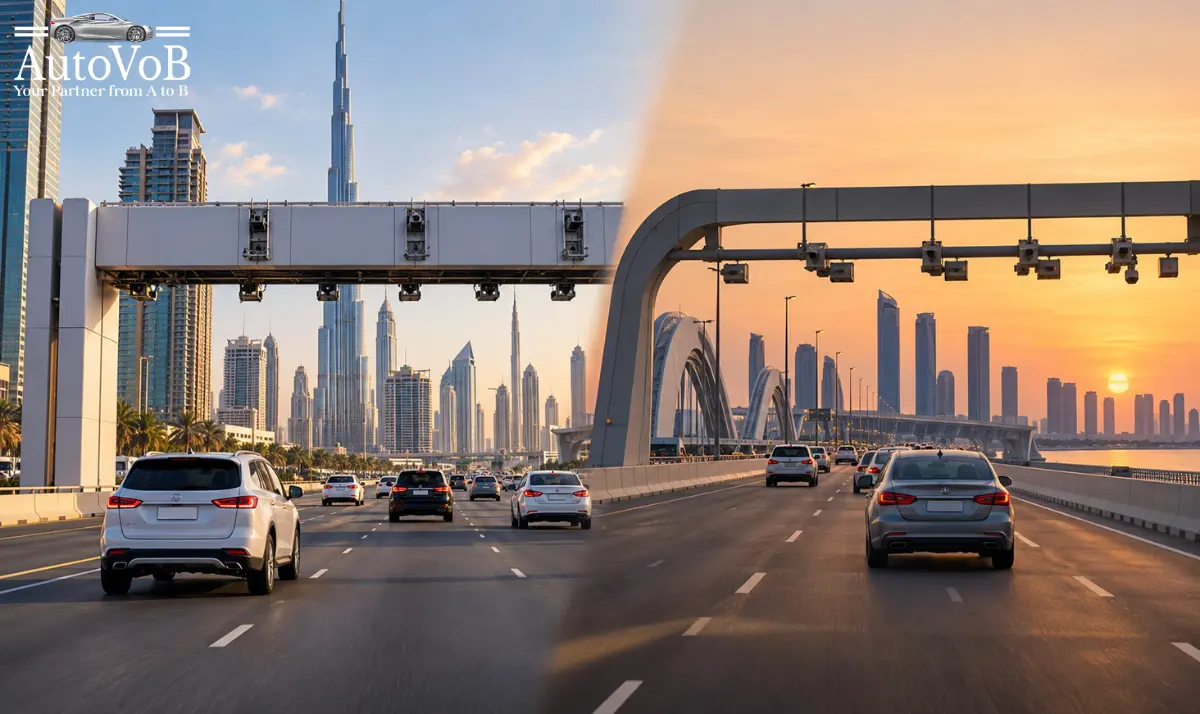
Since 1 June, a peak-hour Salik crossing in Dubai costs AED 6.30 and an off-peak one AED 4.20, because 5% VAT now sits on top of the old tariff. In the capital, Darb no longer has a daily cap, and two of its six gates charge around the clock. If you drive between the two emirates, your toll bill has changed more in the past year than in the decade before it.
Here's how Salik Dubai pricing and the Darb toll in Abu Dhabi work right now, what the fines look like, and where I think drivers are losing money without noticing.
How Salik Dubai tolls are priced now
Salik has run variable pricing since 31 January 2025. From Monday to Saturday, crossings between 6am and 10am and between 4pm and 8pm count as peak and cost AED 6 before VAT. From 10am to 4pm and from 8pm to 1am, you pay AED 4. Between 1am and 6am, you pay nothing. On Sundays the charge is AED 4 all day outside that free night window, unless a public holiday or major event brings its own tariff. Ramadan runs on a different clock, with AED 6 from 9am to 5pm, AED 4 from 7am to 9am and from 5pm to 2am, and free crossings between 2am and 7am.
The VAT arrived on 1 June 2026. Salik says the underlying tariff hasn't changed and the tax goes straight to the Federal Tax Authority. It also referred to a retrospective VAT amount for July 2022 to May 2026, which it will settle with the RTA without billing motorists for it.
Dubai has ten gates. Al Barsha, Al Safa North, Al Safa South and Jebel Ali sit on Sheikh Zayed Road. The rest are Business Bay Crossing on Al Khail Road, Al Garhoud Bridge, Al Maktoum Bridge, the Airport Tunnel on Beirut Street, and Al Mamzar North and South on Al Ittihad Road. Two pairs are linked. Pass both Al Safa gates, or both Al Mamzar gates, in the same direction within an hour and you pay once.
Timing costs you more than the VAT
People grumbled about the VAT, and I understand why, but the amounts are small. Take a commuter who crosses two Salik gates each way in peak hours, five days a week. That's four crossings a day at AED 6.30, or AED 25.20. Over 22 working days it comes to AED 554.40, and the VAT accounts for AED 26.40 of that.
Now move the morning drive past 10am and the evening one past 8pm. The same four crossings cost AED 4.20 each, which is AED 16.80 a day and AED 369.60 a month. Leaving later saves AED 184.80, about seven times what the VAT added. Not everyone can change their hours. If your employer allows flexible starts, though, the Salik rate table makes a stronger case for using them than anything HR will send you.
Getting a tag and handling Salik recharge
Every vehicle needs its own tag, and you can't move one to another car. Bought online, the package costs AED 122.50: AED 52.50 for the tag including VAT, AED 50 of toll balance and AED 20 for delivery. At an authorised agent, including ENOC, ADNOC and Emarat stations, it's AED 102.50 because there's no delivery charge. Online tags activate once payment is confirmed and usually arrive within five working days. A petrol station tag has to be activated manually before your first gate, through the Salik website or app, the RTA Dubai app or the Salik call centre.
You can do a Salik recharge on the Salik website, the Smart Salik app or the RTA Dubai app, at petrol stations and kiosks, or with a prepaid recharge card. Top-ups go in multiples of AED 50, from AED 50 up to AED 50,000 per transaction. One account can hold several tags, which is how I'd run a household with two or three cars.
Turn on auto-recharge. I've watched plenty of owners collect fines because the low-balance text went to a phone number they stopped using years ago. With variable pricing, a balance that used to last a month can run out in two weeks.
Darb toll in Abu Dhabi works differently
Darb doesn't use a sticker. Cameras read your number plate, so you register the vehicle itself on the Darb app or website, where you sign in with UAE Pass. Registration costs AED 100 per vehicle. Half of that is the fee, and the other AED 50 goes into your wallet as toll credit. Cars with Dubai, Sharjah or any other emirate's plates have to register too, and your Salik balance counts for nothing at a Darb gate.
Every crossing costs AED 4. At the four original gates on the Sheikh Zayed, Sheikh Khalifa, Al Maqta and Mussafah bridges onto Abu Dhabi island, you pay from 7am to 9am and from 3pm to 7pm, Monday to Saturday. Sundays and official public holidays are free there.
Two changes hit regular drivers hard. On 1 September 2025, Abu Dhabi scrapped the AED 16 daily cap and the monthly caps of AED 200, AED 150 and AED 100, which depended on how many cars you had registered, and moved the evening start from 5pm to 3pm. Then on 4 May 2026, the ITC opened two gates that charge AED 4 at any hour, every day of the week. Ghantoot sits on Sheikh Maktoum bin Rashid Street near the Dubai border, and Al Qurm is on Wahat Al Karama Street at the entrance and exit of Sheikh Zayed Street.
Together, those changes put a real price on the Dubai to Abu Dhabi commute. Cross Ghantoot and one island bridge each way, with the bridge crossings in peak hours, and you pay AED 16 a day, or AED 352 over 22 working days. Before September 2025, the monthly Darb bill for a first car couldn't go above AED 200. If you want to skip the new gates, the ITC's suggested alternative to Ghantoot is Sheikh Mohammed bin Rashid Al Maktoum Street, and for Al Qurm it's Sheikh Rashid bin Saeed Street or Arabian Gulf Street.
Senior citizens, People of Determination, low-income citizens and retired citizens can apply to exempt one vehicle each. Ambulances, armed forces and civil defence vehicles, public transport buses, motorcycles and licensed Abu Dhabi taxis don't pay at all.
Fines on both systems
Both systems punish a missing registration the same way. Drive through a Salik gate without a tag and you have 10 working days to buy, activate and fit one. After that, it's AED 100 for the first trip, AED 200 for the second and AED 400 for each trip after, with a limit of one violation per vehicle per day. Darb also gives you 10 working days to register and then uses the same AED 100, AED 200 and AED 400 steps.
Low balance is where they split. Salik gives you five working days to top up, then fines you AED 50 for each day you made trips. Darb also allows five working days but fines AED 50 per transaction, and that rule targets vehicles with plates from outside Abu Dhabi. That's the trap for Dubai drivers who treat Darb as an afterthought. Tampering with a plate to dodge Darb, or damaging a gate, costs AED 10,000.
Rental cars usually come fitted with a Salik tag, and you pay for your crossings when the lease ends. Check that statement line by line before you agree to any deduction from your deposit.
Also Read: International Driving License in Dubai: How & Where to Apply
Before you plan a new commute
The Salik Dubai and Darb details above reflect current information from Salik, the Integrated Transport Centre and official announcements as of September 2026. The Dubai and Abu Dhabi governments, the RTA and the ITC can change toll rates, timings, gates and fines at any time, so check the Salik and Darb apps before you commit to a new route or pick a home around a commute.
If you drive in both emirates, set up both accounts, put both on auto top-up and link them to the phone number you actually use. After that, the clock is your biggest saving. Crossing Dubai's gates after 10am, or reaching Abu Dhabi's bridges before 7am, takes more off your toll bill than the VAT ever put on it.
FAQs
1. How much does a Salik crossing cost in Dubai after VAT?
Since 1 June 2026, a peak crossing costs AED 6.30 and an off-peak crossing AED 4.20, including 5% VAT. Peak runs 6am to 10am and 4pm to 8pm, Monday to Saturday. Sundays are AED 4 plus VAT all day, and every one of the ten gates is free from 1am to 6am, or 2am to 7am during Ramadan.
2. What are the Darb toll timings in Abu Dhabi?
The four island bridge gates charge AED 4 per crossing from 7am to 9am and 3pm to 7pm, Monday to Saturday, and are free on Sundays and public holidays. The Ghantoot and Al Qurm gates, opened on 4 May 2026, charge AED 4 at any hour, every day, holidays included, with no daily cap.
3. How do I do a Salik recharge?
Top up through the Salik website, the Smart Salik app, the RTA Dubai app, petrol stations, kiosks or a prepaid recharge card. Amounts go in multiples of AED 50, from AED 50 up to AED 50,000 per transaction. Turning on auto-recharge is the easiest way to avoid fines.
4. Do Dubai-registered cars need to register for Darb?
Yes. Darb reads number plates, so any car using Abu Dhabi's toll gates must be registered, whichever emirate issued the plates. Registration costs AED 100 per vehicle, with AED 50 added to your wallet as toll credit. A Salik tag or balance does not work at Darb gates.
5. What is the fine for driving with a low Salik or Darb balance?
Salik gives you five working days to top up, then fines AED 50 for each day you made trips. Darb also allows five working days, then fines AED 50 per crossing for vehicles with plates from outside Abu Dhabi. Auto top-up on both accounts avoids either penalty.
Keep reading AutoVoB Blogs for more expert insights on cars and other vehicles.