Used Cranes in UAE: Mobile vs Tower, What to Check
A used crane can look spotless, run smoothly and still be useless on a Dubai site. Dubai Municipality won't let it lift until a third party accredited by the Emirates International Accreditation Center (EIAC) has tested and certified it, and that has to happen again every 12 months. Before you compare boom lengths or argue over price, find out whether the machine can be certified, registered and legally run in the emirate where it'll work. In my experience, that's the question most used crane UAE deals fail on, not the engine or the paint.
Why buyers have some leverage right now
UAE contract awards cooled in the second quarter. Projects worth $20.5 billion were awarded, 5.4% less than a year earlier, and construction made up $6.74 billion of that. Regional tensions weighed on activity, and the UAE's share of Gulf project awards fell to 34.4% from 47.3% a year before, according to Kamco Invest.
My read is that a slower pipeline pushes more idle cranes onto the market, usually from contractors whose next job slipped. That's good for price. It also means more worn-out machines get listed as bargains, so the checks below matter more than usual.
Mobile or tower: buy for the work you actually have
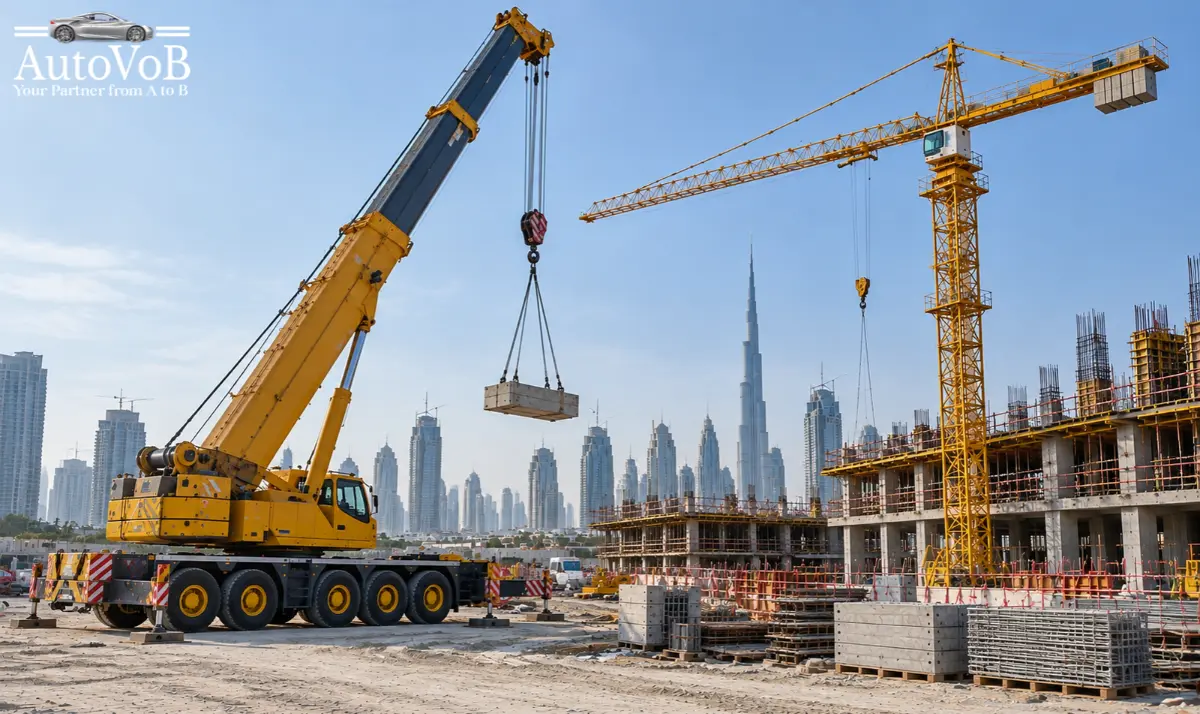
A mobile crane makes money by moving: a few days on a villa plot, a week at a warehouse, a night shift at a substation. A tower crane makes money by standing over one high-rise for a year or more. If your work is varied and short, a tower crane will spend more time in a yard than in the air.
The rules split along the same line. In Dubai, a mobile crane is registered with the RTA as heavy mechanical equipment. Registration costs AED 1,000 for private use or AED 1,300 for public, plus a AED 20 knowledge and innovation fee, and the machine must pass a traffic safety test. Changing ownership of a used one costs AED 800 private or AED 1,000 public.
A mobile crane also lives under truck rules. From 1 October 2026, the RTA and Dubai Police are enforcing peak-hour truck restrictions across the emirate, with 24-hour bans on Al Qudra Street, Al Meydan Street, the marine crossings and the Airport Tunnel. The RTA's conditions for companies renting out wheeled lifting equipment also cap self-driven moves at 15 km and keep the machines off highways. A cheap crane that needs a low-loader for every site change isn't that cheap.
A tower crane never gets a plate, but it carries other costs: foundations, erection and climbing crews, dismantling and transport. Height brings in the aviation authorities too. Dubai's airspace law lists cranes among the structures that add height in the emirate's airspace, which puts tall ones under the Dubai Civil Aviation Authority's oversight.
My view is simple. Unless you run a rental fleet or have several years of high-rise work lined up, a used mobile crane is the easier machine to keep busy and to sell on.
What to check on a used mobile crane
Start with the certificate. Dubai Municipality's guideline says it must list the serial number, technical details, tests carried out and safe working load, and that it's issued only after any repairs the inspector called for are done. Any re-rating of the safe working load has to appear on it. A re-rated crane isn't automatically a bad buy, but I'd want a straight answer on why a 50-tonne machine is now certified for less. Then match the serial number to the plate on the chassis.
Next come the parts that cost real money. Rock the boom at short radius and watch the slewing bearing, because visible play there means a major repair. Run every boom section out and look for scoring, weld repairs and worn wear pads. Check the outrigger beams and jacks for cracks and weeping seals, since they carry the full load on every lift. Test the load moment indicator and the anti-two-block system with the operator, not just the dashboard lights. Walk the length of the wire rope looking for broken wires, kinks and crushed sections. If the crane records upper and carrier hours separately, compare them. A big gap tells you whether it spent its life driving between jobs or lifting.
Hoses and seals deserve a slow look in this climate. Years of summer heat harden rubber, and a leaking cylinder on a crane you've just paid for is the worst kind of surprise.
What to check on a used tower crane
The year on the plate matters less than the work the crane has done. ISO 12482 sets a crane's design working period from how often and how heavily it lifts. When a crane approaches those design limits, the standard calls for a special assessment covering every part before it's used again. Ask the seller for usage records or data logger output. If nobody can tell you how many cycles it has done, price it as though it's close to the limit.
Count the kit as well as the crane. Mast sections, ties, the base or anchors, the climbing frame and the counterweights all need to be there and match the model. Look for cracks around welds and pin holes on the jib and mast, oval pin holes and corrosion at the base. A fair price on the crane turns bad quickly if you then have to source a climbing frame or a run of mast sections from the manufacturer.
Then make sure it can be certified here. Dubai Municipality and the Dubai Development Authority both require EIAC-accredited inspection, and the DDA's March 2025 circular tells contractors to check an inspection company's accreditation status and scope before hiring it. Scope is the catch. A firm accredited for mobile cranes isn't necessarily accredited for tower cranes, so confirm its scope covers the machine you're buying.
Paperwork that makes or breaks a used crane UAE purchase
The crane is only half of what you need. Dubai Municipality's guideline, updated in January 2025, requires crane operators, riggers and signalpersons to be certified by an EIAC-accredited third party, and the institutes that train them must be approved by the Knowledge and Human Development Authority. A crane without a certified crew is a parked crane.
Ask for the maintenance history too. The DDA requires complete maintenance records to be kept on site, and a seller who can't produce them is telling you how the crane was looked after. If an inspector finds the equipment unsafe, the municipality's guideline says the owner must be told to stop using it and the Health and Safety Department must be informed straight away.
Location changes the rules. Dubai's Decree No. 19 of 2025 makes its construction safety code binding across the emirate, free zones included. Abu Dhabi has required third-party test certificates on cranes since 2011 and runs its own inspection regime. Imports add a step, since the RTA asks for an electronic customs certificate before it will register imported equipment. When you browse used cranes for sale in UAE listings, assume nothing carries over automatically between emirates, inspectors or owners.
Also Read: Complete Heavy Equipment Maintenance Guide for Longevity
Before you sign
Everything here reflects current information from Dubai Municipality, the RTA, the Dubai Development Authority and published market data as of October 2026. The UAE government and emirate authorities can change certification, registration, truck movement and safety rules at any time, so confirm the latest requirements with the relevant authority and your inspector before you buy.
If I were buying tomorrow, I'd book my own EIAC-accredited inspector before paying a deposit and write the sale so it only completes once the crane passes. Plenty of used cranes for sale in UAE yards will pass a test lift with the seller watching. The ones worth buying also pass an inspector who works for you.
FAQs
1. Does a used crane need a new inspection certificate in Dubai?
Yes. Dubai Municipality requires cranes to be tested and certified every 12 months by a third party accredited by the Emirates International Accreditation Center. The certificate must show the serial number, tests done and safe working load, and it must be kept on site.
2. How much does it cost to register a used mobile crane with the RTA?
RTA charges AED 1,000 to register private heavy mechanical equipment and AED 1,300 for public use, plus a AED 20 fee. Transferring ownership of a used heavy unit costs AED 800 private or AED 1,000 public, and the machine must pass a traffic safety test.
3. Is a mobile crane or a tower crane the better used buy in the UAE?
For most buyers, a mobile crane. It moves between short jobs and is easier to resell. A tower crane suits one long high-rise project and adds foundation, erection, climbing and aviation costs, while mobile cranes face RTA registration and Dubai truck limits.
4. How do I judge the age of a used tower crane?
Look at the work it has done, not just the year it was built. ISO 12482 bases a crane's design working period on how often and how heavily it lifts, and calls for a special assessment of every part as it nears that limit. Ask the seller for usage records.
5. Do crane operators need certification in Dubai?
Yes. Dubai Municipality's guideline, updated in January 2025, requires crane operators, riggers and signalpersons to be certified by an EIAC-accredited third party. The institutes that train them must also be approved by the Knowledge and Human Development Authority.