Flooded Car? 6 Ways to Spot a Water Damaged Car Before Buying
Every monsoon season, thousands of vehicles drown. Some get written off. Many get cleaned up, shipped a few hundred kilometres away, and sold to someone who never asks the right questions.
A flooded car is one of the worst used-car purchases you can make. Not because it looks bad, but because it looks fine. Detailers know how to make a submerged sedan shine. What they cannot do is undo what water did to the wiring harness, the ECU, the airbag sensors, and the metal underneath the carpet.
Here is how to catch a water damaged car before your money leaves your hands.
Why Flood Cars Keep Coming Back
Insurance companies total flooded vehicles. Those cars get auctioned. Rebuilders buy them cheap, dry them out, replace the obvious stuff, and put them back on the market. In markets with weak title-branding rules, the paperwork often says nothing.
Sellers rarely lie outright. They just do not mention it. A common line is that the car was garaged during the floods. Ask for proof, not reassurance.
The pattern repeats after every major flood event. Vehicles appear for sale in regions that never flooded, priced slightly below market, with clean-looking interiors and vague service histories.
Start With Your Nose
Sit inside with the doors closed and the AC off. Give it a full minute.
Mildew has a specific smell. Damp, sour, faintly like a basement. If it is there, walk away. If you smell nothing but aggressive air freshener or shampoo, that is worse. Nobody deep-cleans a used car interior for fun. They do it to cover something.
Run the AC on full blast. Sometimes the smell only appears once air moves through the vents. Musty air blowing out of an evaporator that sat underwater is unmistakable.
Look Where Water Settles
Water finds the lowest point and leaves evidence there. That evidence outlasts any detailing job.
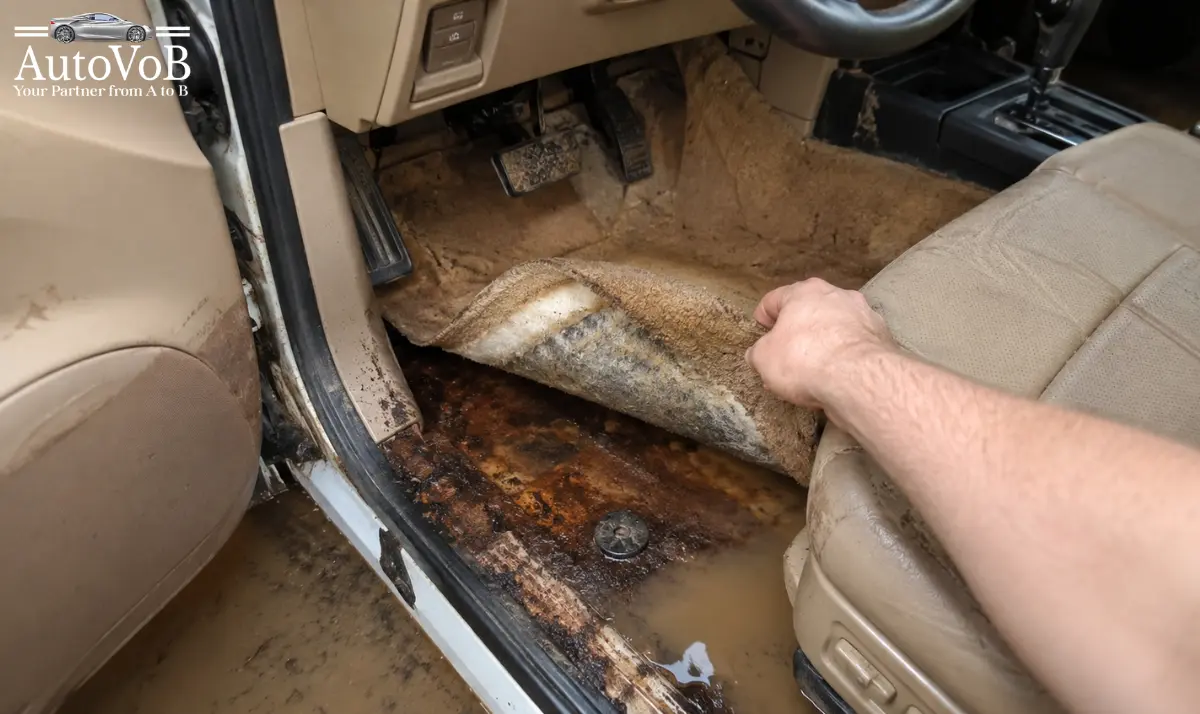
Under the carpet. Peel back the floor mats, then lift the carpet at the edges. Look at the padding underneath. Damp padding, stains, or crusted mineral residue means water sat there. Also check whether the carpet fits properly. Aftermarket carpet in a ten-year-old car with an otherwise worn interior is a mismatch worth questioning.
Under the seats. Slide the front seats all the way forward and back. Look at the seat rails and the bolt heads. Surface rust on the tracks of a car that has never been outside in weather does not happen naturally.
In the spare tyre well. Lift the boot floor. This is the single most reliable place to check. Silt, water lines, rust flakes, or a spare tyre that looks newer than everything around it are all warning signs. Sellers forget this spot.
Seat belts. Pull each belt out to its full length. Look at the webbing near the very end, the part that normally stays wound in the retractor. Water stains, discolouration, or a faint tide line show up here even after the visible portion has been cleaned.
Door sills and hinges. Open every door and look at the bottom of the frame. Check the hinge pins, the striker bolts, the latch mechanism. Rust in these places on a car with no accident history is a red flag.
Check the Electronics Properly
Electrical faults are among the most common problems with flooded cars, and they surface months after the sale. Water corrodes connectors slowly. The car works fine on the test drive and starts failing in six weeks.
Turn the ignition to accessory. Every warning light on the dash should illuminate, then go out once the engine runs. If a light never comes on at all, someone may have removed the bulb.
Test everything. Power windows, one at a time, both directions. Mirrors. Seat adjusters. Sunroof. Interior lights. Boot release. Horn. Every speaker, individually, using the balance and fade controls. Reverse camera. The infotainment touchscreen.
Anything that hesitates, flickers, or works intermittently deserves suspicion. A window that goes down smoothly and struggles coming up is a motor drawing extra current through a corroded connection.
Pull the fuse box cover in the cabin and look at the fuse legs. Green or white powder on brass is corrosion. Also check the terminals under the bonnet, particularly the main battery ground.
Under the Bonnet and Underneath
Open the bonnet and look at the underside of it. Water marks, mud spray, or rust up there mean the engine bay filled with water.
Check the air filter. Pull the housing open if the seller allows it. A stained filter, or water inside the airbox, tells you a lot. So does a filter that looks brand new in a car with 90,000 kilometres and no recent service record.
Look at the dipstick. Oil contaminated with water goes milky, a light brown foam. Do the same with the transmission fluid where accessible. Check the brake fluid reservoir for cloudiness.
Get underneath with a torch if you can. Look at the exhaust, the suspension components, the subframe, the brake lines. Uniform surface rust across the underbody of a car from a dry region is inconsistent. Fresh undercoating sprayed over everything is a way to hide it.
Look for silt in places nobody cleans. Behind the bumper. Inside the wheel arches. In the gap where the wiring harness passes through the firewall. Where the seat belt anchors bolt to the floor.
Verify the History
Physical inspection catches most of it. Paperwork catches the rest.
Run the VIN through whatever vehicle history service operates in your market. Look for a salvage title, a flood brand, a total-loss record, or an insurance claim. Compare registration locations against known flood events. A car that was registered in a flood-hit district in the months around a major event, then quietly moved elsewhere, deserves hard questions.
Cross-check the service history against the odometer. Gaps in servicing during a flood period, followed by a large unexplained repair bill, tell a story.
Ask the seller directly, in writing, whether the vehicle has ever been submerged or subject to a flood-related insurance claim. Get the answer over text or email. If they lied and you can prove it, that message matters later.
Pay Someone Who Knows
Independent pre-purchase inspection. Every time, on every used car, but especially when anything feels off.
A mechanic with a lift and a scan tool will find things you cannot. Stored fault codes that were cleared but logged. Corroded ground points. Moisture in a control module. The cost is trivial next to what a waterlogged car will drain from your account over the following two years.
If a seller refuses an independent inspection, that refusal is your answer.
What Water Actually Ruins
Understanding the mechanism helps you take this seriously.
Water carries dissolved salts and minerals. It gets into connectors, into the copper strands inside insulated wire, into control modules, into the airbag system's crash sensors. It dries. The salts stay. Corrosion begins and does not stop.
The engine and gearbox can often be saved if water never entered the cylinders. The electronics cannot be saved, only replaced, and modern cars have dozens of modules talking to each other over a data network. One corroded module can bring down systems that seem unrelated to it.
Then there is safety. Airbag control units and their sensors are sealed to a standard that assumes rain, not immersion. A submerged airbag system may deploy late, deploy early, or not deploy. You will find out at the worst possible moment.
Rust does the rest, working outward from inside sills and floor pans where nobody looks until the metal gives.
Also Read: Freeze Plug in Cars: Functions, Signs and Replacement
The Rule Worth Remembering
A price that seems too good usually is. A flooded car does not announce itself. It waits.
Trust your nose, lift the carpet, check the boot well, test every switch, run the VIN, and pay for an inspection. Do those six things and you will avoid nearly every flood car on the market.
FAQs
1. Is Water Damage Covered by Car Insurance?
Comprehensive car insurance generally covers flood and water damage, while third-party-only policies usually do not. However, engine damage caused by hydrostatic lock is often excluded unless you have an engine protection add-on. Since coverage and exclusions vary between insurers, always review your policy documents carefully before making a claim.
2. Can a Flood Damaged Car Be Repaired?
Yes, a flood damaged car can sometimes be repaired, but the extent of the damage depends on how high the water reached. If the flooding was limited to below the floorboards, repairs may be practical. However, if water entered the dashboard area, critical components such as the wiring harness, electronic control modules, and sensors may be permanently affected. In many cases, the repair costs outweigh the vehicle's value, and long-term reliability remains questionable.
3. What Are the Most Common Problems With Flooded Cars?
Electrical issues are the most common problems in flooded vehicles. Owners often experience malfunctioning power windows, faulty sensors, infotainment failures, and random dashboard warning lights. Floodwater also causes corrosion in electrical connectors and grounding points, encourages mould growth inside the cabin and air conditioning system, compromises airbag components, and accelerates rust in hidden structural areas such as floor pans and sills.
4. How Can I Tell if a Used Car Has Been in a Flood?
Start by checking the cabin for a musty or mildew smell. Lift the floor carpet to inspect the padding for dampness, stains, or residue. Examine the spare tyre well for rust, silt, or water marks, and pull each seat belt completely out to look for water stains near the end of the webbing. Test every electrical feature, including windows, lights, mirrors, and infotainment. Finally, verify the vehicle's VIN history and arrange an independent pre-purchase inspection for added peace of mind.
5. Is It Ever Safe to Buy a Waterlogged Car?
A waterlogged car should only be considered if the seller fully discloses its flood history, provides documented repair records, and allows an independent inspection. Even then, these vehicles typically have lower resale value, may face insurance limitations, and carry a higher risk of future electrical and mechanical problems. For most buyers, avoiding a flood damaged car is the safest and most cost-effective decision.
For more such informative blogs, keep following AutoVoB blogs.
Explore AutoVoB, your global marketplace to buy and sell vehicles worldwide.