Exhaust Smoke Color: What It Says About Your Engine
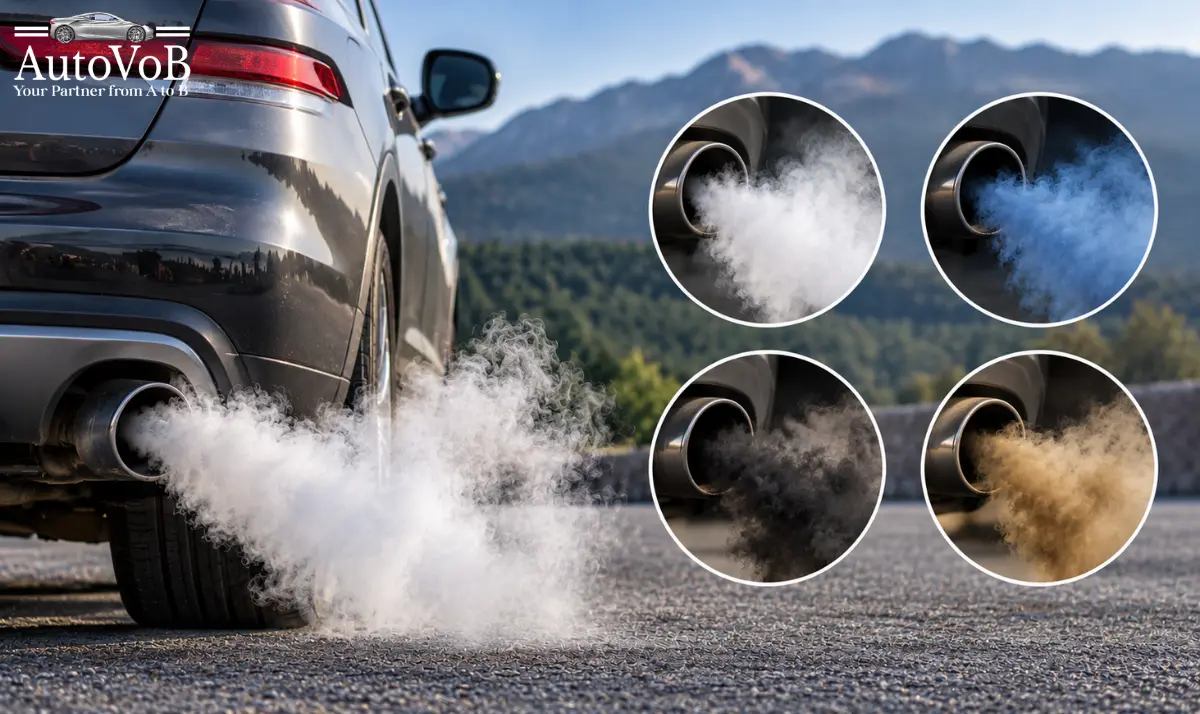
A thin white puff on a cold morning is water, and it means nothing. A thick white cloud that's still rolling out ten minutes into a drive, and smells faintly sweet, can mean coolant is getting into the cylinders. Exhaust smoke color is one of the cheapest diagnostic tools you'll ever have, and I'd rather a buyer learned to read it than spent money on a code reader they don't know how to use.
Color alone won't name the faulty part. When the smoke appears, how long it lasts and what it smells like narrow things down fast, and that's usually enough to tell a top-up from a big bill.
Thin white vapor is usually just condensation
Burning fuel makes water. When a cold engine starts, that water condenses inside the exhaust and leaves the tailpipe as steam until the system warms through. You'll see it on almost any healthy car on a cold or wet day, and it should vanish within seconds.
Hybrids can do this well into a journey, plug-in hybrids especially, because the petrol engine may not start until the battery has done its share. That's normal too.
Short trips are the habit to worry about. If the exhaust never gets hot enough to dry out, the water rusts it from the inside, and a leaking exhaust can throw off emissions readings at a roadworthiness test.
Thick white smoke that won't clear points to coolant
If the white smoke is dense, hangs in the air and keeps coming after the engine is fully warm, treat it as coolant until someone proves otherwise. The usual culprit is a failed head gasket, the seal between the engine block and the cylinder head. A cracked head or block causes the same symptom and costs far more to fix.
Coolant smoke tends to smell sweet. Check the coolant level with the engine cold. If it keeps dropping with no puddle under the car, or the oil on the dipstick looks milky, the coolant is going somewhere it shouldn't. Stop driving if the temperature gauge starts to climb. A small leak left alone can end with a ruined engine, and on an older car that often means a write-off.
Diesels make their own kind of white smoke
A diesel that blows white smoke for a minute after a cold start, and smells strongly of diesel, is usually pushing out unburnt fuel because the cylinders aren't hot enough to light it properly. Failing glow plugs are the common cause, and hard starting on cold mornings often shows up before the smoke does. Faulty injectors and low compression can do the same. If the smoke smells of fuel and clears once the engine is warm, I'd test the glow plugs before anyone mentions a head gasket.
Blue or gray smoke means the engine is burning oil
Blue-gray smoke, often with a burnt smell, means oil is reaching the combustion chamber or a hot part of the exhaust. A lighter haze generally means less oil is burning.
Start with the cheap explanations. A freshly serviced car may have been overfilled, or oil may have spilled onto the exhaust during a top-up. Both burn off and stop. On a high-mileage engine, worn valve stem seals or piston rings are more likely. As a rough guide, smoke under hard acceleration tends to point at the rings, while a puff when you get back on the throttle after a long downhill coast points at the valve guides and their seals. On a turbocharged car, worn turbo seals produce the same blue haze. None of these is a small job.
Gray smoke can be oil too, but there are two other suspects. A faulty PCV valve, which routes gases from the crankcase back into the intake, can make smoke that looks alarming and costs relatively little to fix. On a car with an automatic gearbox, transmission fluid being drawn into the engine is a much bigger bill and needs a mechanic quickly.
If you see blue smoke, measure how much oil the engine really uses. One engine parts maker's technical guidance puts typical consumption in a modern passenger car below 0.05% of the fuel burned, with 0.5% as the usual maximum. For a car using 8 litres per 100 km, that's about 0.04 litres of oil per 1,000 km normally and 0.4 litres at the limit. Your owner's manual may give a different figure, since manufacturers set their own, and diesels generally use more oil than petrol engines.
Black smoke means too much fuel and not enough air
On a petrol car, black smoke means the engine is running rich. Check the air filter first, because it's cheap and easy to replace. If that's clean, clogged injectors or a faulty fuel pressure regulator come next, and those are jobs for a workshop.
Diesels are more complicated. A diesel particulate filter traps soot and burns it off from time to time, but a car that only does slow town driving can't get the filter hot enough, and a warning light comes on. A sustained run at motorway speed often clears it, sometimes with a visible cloud of soot. If the light keeps coming back, a diesel may simply be the wrong car for how you drive, and I'd tell any buyer who only does the school run exactly that.
A used diesel that pours out black smoke in normal driving deserves a look underneath. Some garages have removed troublesome filters instead of fixing them. That car will keep sooting up the road behind it, and it's heading for a failed inspection.
What testers and regulators make of car exhaust smoke
Some countries write smoke straight into the roadworthiness test. Under Britain's MOT inspection manual, a petrol car gets a major defect if it emits dense blue or clearly visible black smoke for five continuous seconds at idle. Since 20 May 2018, any diesel with a particulate filter fails if the tester sees visible smoke of any color during the metered smoke test, and evidence of tampering with the filter is a major defect too. Diesels first used from 1 January 2014 face a default smoke limit of 0.7m-1 unless the manufacturer's plate gives a different figure.
The tougher test bit hard. In its first six months, 238,971 diesel cars failed on emissions, against 58,004 in the same period a year earlier, and 505,721 petrol cars failed too.
Elsewhere, the enforcement happens on the road. California lets anyone report a smoking vehicle to its Air Resources Board, which writes to the owner asking them to have it checked. The letter itself carries no legal obligation, but excessive tailpipe exhaust breaks the California Vehicle Code, and police can issue citations for it.
These rules reflect current government information, and governments can change inspection standards and smoke limits at any time, so check with your local testing authority before you rely on them.
Also Read: Car Air Bags Explained, Types, Safety, and Care
Checking for smoke coming out of the exhaust on a used car
For buyers, reading car exhaust smoke starts with a cold engine. Tell the seller you want the engine cold when you arrive, and put your hand on the bonnet before anyone turns the key. A pre-warmed engine hides glow plug and valve seal smoke, so I treat a warm bonnet on arrival as a reason to come back another day.
Watch the tailpipe for the first minute, then again once the engine is fully warm. Ask the seller to rev it while you stand behind the car, and on the test drive check the mirror after a long coast downhill. Look at the coolant level and the dipstick before and after. In the UK, the free MOT history check shows past emissions failures and advisories, which tells you whether the smoke is a new problem or an old one.
For sellers, fix the cheap causes first. A clogged air filter or an overfilled sump costs little to sort out and a lot more in price talks once a buyer sees black or blue smoke. If the cause is expensive, price the car honestly, because a buyer who knows what to look for will spot it anyway.
Most smoke from a tailpipe is harmless steam. The rest tells you something specific once you note when it appears, which is why exhaust smoke color is worth learning. Tell a cold-morning puff from a cloud that follows the car down the road, and you'll walk away from bad cars before paying for an inspection, and catch your own car's problems while they're still cheap to fix.
FAQs
1. Is white smoke from the exhaust always a problem?
No. Thin white vapor on a cold or wet morning is condensation and should vanish within seconds. Thick white smoke that keeps coming after the engine is warm, especially if it smells sweet and the coolant level drops, can point to a failed head gasket.
2. What does blue smoke from a car exhaust mean?
Blue or gray-blue smoke means the engine is burning oil. On a freshly serviced car it may be overfilled oil or a spill burning off. On a high-mileage engine, worn valve stem seals, piston rings or turbo seals are more likely, and none of them is cheap to fix.
3. Why does my diesel blow black smoke?
Black smoke means too much fuel for the air available. On a diesel it often comes from soot clearing out of the particulate filter after slow town driving. If it happens in normal driving, check that the filter is still fitted, because some garages have removed them.
4. Can exhaust smoke make a car fail its MOT?
Yes. A petrol car gets a major defect for dense blue or clearly visible black smoke for five seconds at idle. Since 20 May 2018, a diesel with a particulate filter fails if any visible smoke shows during the metered smoke test. Rules can change, so check locally.
5. How should I check exhaust smoke on a used car?
Ask for the engine to be cold when you arrive and feel the bonnet first. Watch the tailpipe at startup and again when warm, have the seller rev it, and check the mirror after a long coast downhill. Look at the coolant and the dipstick before and after.