Car Dashboard Warning Lights: What Each Symbol Means?
A light on your dashboard isn't a suggestion. It's a message with a deadline, and the colour tells you how much time you've got before the repair bill grows.
Most drivers learn this the expensive way. They keep driving on a red oil pressure light, then act surprised when the engine needs opening up. Car dashboard warning lights follow a colour logic that's been standardised for decades, and once you know that logic, the cluster stops looking like a puzzle and starts reading like a set of instructions.
The colour tells you how fast to react
Carmakers don't invent these symbols. Most follow ISO 2575, the international standard for symbols on vehicle controls, indicators and tell-tales, now in its ninth edition published in 2021. In the United States, FMVSS 101 covers similar ground for displays. That's why a Toyota, a Nissan and a BMW all use roughly the same oil can icon.
The standard also sets the colours. Red signals danger or a serious malfunction. Yellow or amber means the vehicle is operating outside normal limits and damage is likely if you keep going. Green means a system is working normally. Blue is used for high beams, and white usually carries information rather than a warning.
The practical translation is short. Red, stop as soon as it's safe. Amber, book the workshop this week. Green, blue or white, nothing is wrong.
Red symbols that mean stop, not slow down
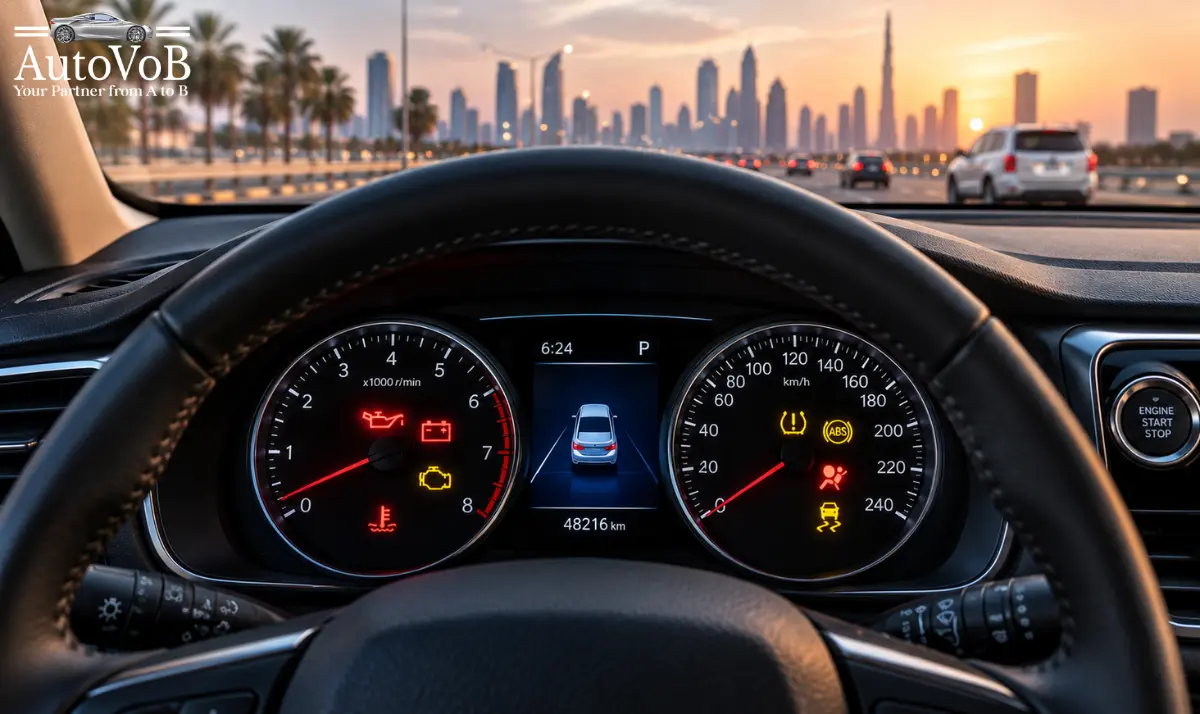
The oil pressure light, the one shaped like an old-fashioned oil can with a drip, is the most misread warning on the panel. It doesn't mean the oil is low. It means oil isn't reaching the engine at pressure, and an engine running without oil pressure can destroy itself in minutes. Pull over, switch off, check the level. If the level is fine, call a recovery truck. Topping up won't fix a failed pump or a blocked pickup screen.
The coolant temperature warning, a thermometer floating in wavy lines, means the engine is running hotter than it was designed to. In Gulf summers this one shows up far more often than the engineers who signed off the cooling system ever planned for. Ignore it and you're looking at a warped head or a failed gasket. Switch the air conditioning off, run the cabin heater on full to pull heat out of the engine, and stop somewhere safe. Don't open a hot radiator cap.
The brake warning light does two jobs, which is why it confuses people. It confirms the parking brake is engaged, and it also reports low brake fluid or a hydraulic fault. If it's still lit after you've released the handbrake, treat it as a brake problem until a technician proves otherwise.
The battery symbol is another one that gets misdiagnosed at the parts counter. It rarely means the battery is dying. It means the charging system has stopped charging, usually a failed alternator or a snapped drive belt. The car is now running on stored charge, and with headlights and air conditioning drawing power, that charge doesn't last long.
Amber car dashboard warning lights and what they're really asking for
The check engine light starts more arguments in service centres than anything else on the dash. A steady amber light means the engine or emissions system has logged a fault code. That code might point to a loose fuel cap. It might point to an oxygen sensor that's quietly wasting your fuel.
A flashing check engine light is a different animal. On-board diagnostic systems watch how much the crankshaft speed varies, and when a misfire gets severe enough to risk cooking the catalytic converter, the light flashes instead of holding steady. That's a pull-over warning, not a deal-with-it-Thursday warning.
The money involved is worth knowing. CarMD's 2026 Vehicle Health Index, built from more than 39 million vehicle service records during 2025, put the average check engine light repair at $554, a 33% jump on the previous year. Labour costs rose 51% and parts 23%. Catalytic converter replacement topped the list of most common repairs at an average of $1,511, and converters usually only fail because a cheaper fault like a bad spark plug or oxygen sensor was left alone.
The tyre pressure symbol, a horseshoe shape with an exclamation mark inside, is not an early warning. Under the US standard FMVSS 138, the alert has to trigger when a tyre sits 25% below the pressure listed on the door placard. By then you're seriously underinflated. Temperature plays with this too, since pressure shifts roughly 1 psi for every 10°F change, so a light that appears on a cool morning and disappears by midday usually means you're hovering right on the threshold. Monitoring systems have been mandatory on new US light vehicles built after 1 September 2007, and on new passenger cars in the EU since November 2014 under Regulation 661/2009.
An ABS light means your normal brakes still work but the anti-lock function is offline, so a panic stop can lock the wheels and cost you steering control. The stability control symbol, usually a car with squiggly lines behind it, flashes while driving when the system is actively intervening, which is the system doing its job. If it stays on steadily, either the system has a fault or someone switched it off.
The airbag symbol, a seated figure with a circle in front, deserves more respect than it gets. It means the restraint system has detected a fault and may not deploy in a crash. The car will drive perfectly well right up until the moment it matters.
Green, blue and white lights aren't problems
Plenty of drivers panic over a symbol that's just telling them a system is switched on. Green usually confirms normal operation, blue almost always means high beams are lit, and white is typically informational. If the icon is one of those colours and nothing feels different, keep driving.
Some of these lights will fail a roadworthiness test
In the UK, DVSA rules treat an illuminated engine malfunction indicator lamp, ABS light, airbag warning or stability control fault as major defects during an MOT, which means an automatic fail even if the car drives normally. Other markets take similar positions during periodic inspection.
Inspection rules and the specific lights covered differ from country to country, and governments can revise them at any time. Everything here reflects current published standards, so check your local transport authority before you book a test.
What to do when a light appears, in order
Read the colour first, then decide whether you're stopping now or driving on. Check the owner's manual, because a handful of symbols are manufacturer-specific and the manual is the only place they're spelled out properly.
If it's amber and the car drives normally, get the codes read. A basic OBD-II scanner costs less than one hour of workshop labour and tells you which system is complaining. One warning worth repeating: don't clear the codes before someone diagnoses the fault. Clearing wipes the readiness monitors the emissions test relies on, and the car may need several drive cycles before it can be tested again.
Also Read: Odometer Fraud: How to Detect Mileage Tampering?
Warning lights and used car deals
Car dashboard warning lights change the value of a used car more than most people expect. If you're buying, a cluster with no lights at all during the ignition self-test is a red flag, not a green one. Every warning lamp should illuminate briefly when you turn the key and then go out. A bulb that never lights has often been removed or disabled to hide something. Watch the cluster through a full start-up sequence before you look at anything else.
If you're selling, fix the cheap ones first. A tyre pressure sensor or a fuel cap costs very little and removes an obvious bargaining chip. Buyers use a lit dashboard to argue the price down by far more than the repair would have cost you.
Dashboard warning lights meanings aren't difficult once you stop treating every symbol as equally urgent. Red means the car is telling you to stop. Amber means it's telling you to plan. The drivers who spend the least on repairs are the ones who respond to a light in the first week rather than the third month, and that habit costs nothing to build.
FAQs
1. What do dashboard warning lights mean?
They signal the status of a vehicle system, and the colour sets the urgency. Red means a serious fault or danger, so stop as soon as it's safe. Amber means the car is outside normal operating limits and needs attention soon. Green, blue and white confirm a system is simply active.
2. Can I keep driving with the check engine light on?
A steady amber check engine light usually lets you drive to a workshop, though the fault should be diagnosed quickly. A flashing light is different: it points to a misfire severe enough to damage the catalytic converter, so stop driving and get the car recovered instead.
3. Does the oil pressure light mean my oil is low?
Not necessarily. That symbol reports a loss of oil pressure, not oil level, and an engine running without pressure can be ruined within minutes. Pull over and switch off immediately. If the dipstick shows a normal level, the fault is mechanical and the car needs towing.
4. Why does my tyre pressure light come on in the morning and switch off later?
Tyre pressure changes with temperature, moving around 1 psi for every 10°F. If a tyre sits near the warning threshold, cool overnight air can trigger the light and afternoon heat can clear it. Check all four tyres cold and reset them to the door placard pressure.
5. Will a dashboard warning light fail a vehicle inspection?
Often, yes. UK MOT rules count an illuminated airbag, ABS, stability control or engine management lamp as a major defect, so the vehicle fails even if it drives normally. Requirements vary by country and can be updated by governments, so confirm your local rules first.
Follow AutoVoB blogs regularly for more expert automotive insights.
From cars to trucks, buy and sell any vehicle worldwide on AutoVoB.