Hydrogen Cars in the GCC: Hype or Future?
Saudi Arabia has finished building the world's largest green hydrogen plant, and its output is headed for ships, not Saudi fuel tanks. The NEOM complex is designed to make up to 600 tonnes of hydrogen a day and turn it into ammonia for export. That gap between making hydrogen fuel and driving on it explains where hydrogen cars stand in the GCC, and it's why I'd tell most buyers here to stop waiting for one.
The region has the money, the sunshine and the political will to become a major hydrogen producer. What it doesn't have yet is a hydrogen car you can buy off a showroom floor and refuel on your commute. As far as I can tell, every one on Gulf roads today belongs to a trial.
The world cooled on hydrogen cars before the Gulf warmed up
Global sales of fuel cell vehicles peaked at 20,704 in 2022 and fell to 12,866 in 2024, according to SNE Research. They recovered to 16,011 last year, up 24.4%, but the analysts put much of that down to a December rush in China before a purchase tax break was halved, plus Hyundai's new Nexo. China took nearly half of all sales and South Korea most of the rest.
Toyota, which put the Mirai on sale in 2014, sold 1,168 fuel cell cars worldwide in 2025, down 39.1%. Honda's CR-V e:FCEV found 185 buyers. The whole of Europe bought 566 hydrogen cars. In Japan, where the government has pushed hydrogen harder than almost anyone, annual sales fell 83% between 2021 and 2025 to 431 cars as refuelling stations closed.
California is the warning I'd show any Gulf buyer. Shell shut all seven of its hydrogen stations for cars there in February 2024, citing supply problems. By the autumn, the state's biggest operator, True Zero, had moved more of its pumps to $36 a kilogram.
Hyundai is the exception. It sold 7,047 fuel cell vehicles in 2025, a 58% jump, after launching a second-generation Nexo with a 6.69 kg tank and a claimed range of more than 700 km. Even so, hydrogen made up only 0.76% of Hyundai's electrified sales and 0.03% of Toyota's.
What hydrogen looks like on Gulf roads
The Gulf has been testing hydrogen cars for almost nine years. Al-Futtaim Motors and Air Liquide opened the region's first hydrogen station at Dubai Festival City in December 2017 for three Toyota Mirai test cars, and the Mirai wasn't on sale in the UAE at the time. In 2023, ADNOC opened its H2GO station in Masdar City, which makes green hydrogen on site with an electrolyser and fuels a test fleet that includes a Tawasul taxi. ADNOC said the pilot is there to judge whether hydrogen vehicles are viable in the UAE over the long term.
Saudi Arabia took a similar path. Aramco and Air Products opened the Kingdom's first hydrogen station in Dhahran in 2019 to fuel six Mirai cars. In October 2024, the Transport General Authority ran a seven-day trial of Mirai taxis in Jeddah with Abdul Latif Jameel Motors. A hydrogen bus later started a 359 km daily route between Dammam and Al Ahsa, and Makkah has run its own bus trials.
Every one of those is a trial. I couldn't find official GCC retail pricing for any hydrogen car, including the new Nexo. When a technology spends nine years in pilots, the pilots are telling you something.
The real bet is making hydrogen fuel, not driving on it
Read the national strategies and private cars barely feature. The UAE's National Hydrogen Strategy targets 1.4 million tonnes a year of low-carbon hydrogen by 2031, rising to 15 million by 2050. It aims to cut emissions in heavy industry, shipping, aviation and land transport by 25% by 2031, and it plans two hydrogen oases, or production hubs, in the same period.
NEOM's $8.4 billion plant finished construction this summer and is being commissioned for operations in 2027. Oman's hydrogen body, Hydrom, is aiming for 1 to 1.25 million tonnes a year by 2030, although a BP-led venture and another involving Engie and Posco have already been scrapped.
My read is that the Gulf wants to sell hydrogen the way it sells oil: in bulk, to Europe and Asia, for steel mills, fertiliser plants and ships. That's a sensible business. It just isn't the same thing as a hydrogen pump at your local petrol station.
Where hydrogen fuel cell cars make sense, and where they don't
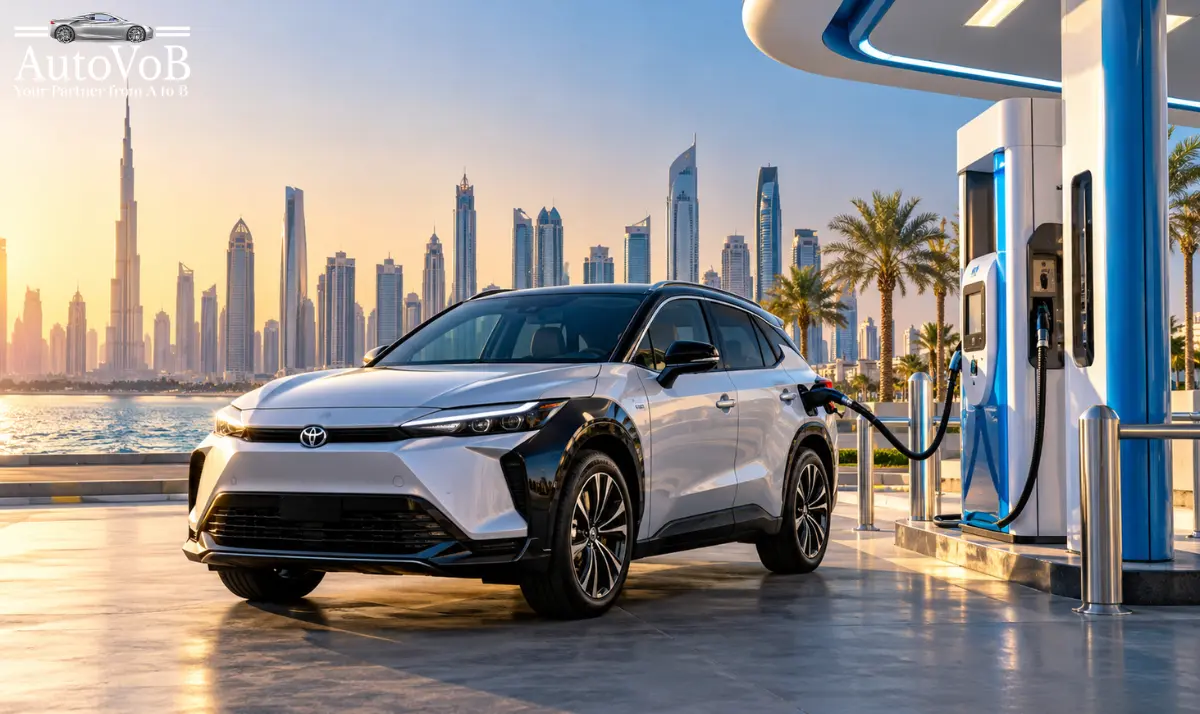
A fuel cell car is an electric car that makes its own electricity. Hydrogen from a high-pressure tank meets oxygen from the air inside the fuel cell, the reaction produces electricity for the motor, and water is the only thing that comes out of the tailpipe. A small battery helps when you accelerate hard.
On paper, that suits the region. Refuelling takes about five minutes, and a 700 km claimed range would cover most runs between Gulf cities on one tank.
The network is the problem. Al-Futtaim's Toyota boss called it a chicken and egg situation back in 2017: you can't sell the cars without stations, and nobody builds stations without cars. Nothing since has broken that loop. Dubai alone had 2,223 EV charging points by the end of the first quarter of 2026, and ADNOC Distribution runs more than 400 more across the UAE. The hydrogen stations I could find in the region were built for test fleets.
That's why I think fleets, not families, are hydrogen's best shot here. Saudi Arabia's Mirai taxi trial quoted a range of 350 km and up to eight hours of work a day. A taxi, bus or truck that returns to the same depot every night needs one station, not a national network. A private owner needs a pump wherever they happen to run low.
Also Read: Essential Tips to Improve Fuel Efficiency of Your Car in UAE
What this means if you're buying or selling
If someone offers you an imported hydrogen car, ask where you'll fill it and if you're even allowed to. A pilot station built for a test fleet isn't a public forecourt. Then ask who will service the fuel cell and the tanks. Hyundai recalled all 1,600 first-generation Nexos in the US and Canada in late 2024 over possible hydrogen leaks, so check the recall history on any used one and get it in writing.
If you're selling one, price it for a tiny audience. Few buyers can refuel it, and the ones who want it tend to be enthusiasts or companies running a pilot. For anyone who wants zero tailpipe emissions today, a battery EV or a hybrid is the practical choice in the GCC.
The details here reflect current information from government strategies, energy companies and market research as of October 2026. GCC governments and their transport and energy authorities can change hydrogen targets, vehicle approvals, incentives and fuel rules at any time, so check with the relevant authority and the dealer before you commit to a hydrogen car.
Hydrogen has a real future in the Gulf, and most of it will leave on tankers as ammonia. Hydrogen cars could follow if a taxi or bus fleet proves the numbers and stations open to the public. Until you can fill one at the same forecourt where you buy your coffee, I'd treat a hydrogen car as something to test drive, not something to own.
FAQs
1. Can you buy a hydrogen car in the UAE or Saudi Arabia?
Not easily. Hydrogen cars in the GCC have so far run in pilots, such as Toyota Mirai taxi trials in Abu Dhabi and Jeddah. Official retail pricing for models like the new Hyundai Nexo hasn't been published, and refuelling is limited to stations built for test fleets.
2. How does a hydrogen fuel cell car work?
Hydrogen stored in a high-pressure tank reacts with oxygen from the air inside a fuel cell. That reaction makes electricity, which drives an electric motor, and the only tailpipe emission is water. A small battery stores extra energy and helps the car accelerate.
3. Where can you refuel a hydrogen car in the GCC?
Options are very limited. ADNOC runs the H2GO pilot station in Masdar City, Dubai's first station opened at Dubai Festival City in 2017, and Saudi Arabia's first opened in Dhahran in 2019. All were set up to serve test fleets, not the general public.
4. Are hydrogen car sales growing worldwide?
Barely. Global fuel cell vehicle sales fell from 20,704 in 2022 to 12,866 in 2024, then recovered to 16,011 in 2025, mostly thanks to China and Hyundai's new Nexo. Toyota's hydrogen sales dropped 39.1% in 2025, and Japan's fell 83% between 2021 and 2025.
5. Are hydrogen cars better than EVs for GCC drivers?
Not today. Hydrogen cars refuel in about five minutes, but the GCC has almost no public hydrogen stations. Dubai alone had 2,223 EV charging points by early 2026, so a battery EV or hybrid is far easier to own, refuel, service and sell on in the region.
For more automotive news and guides, keep checking AutoVoB Blogs.